

User guide · running your garden · 6 min read
Find out what your garden is actually worth.
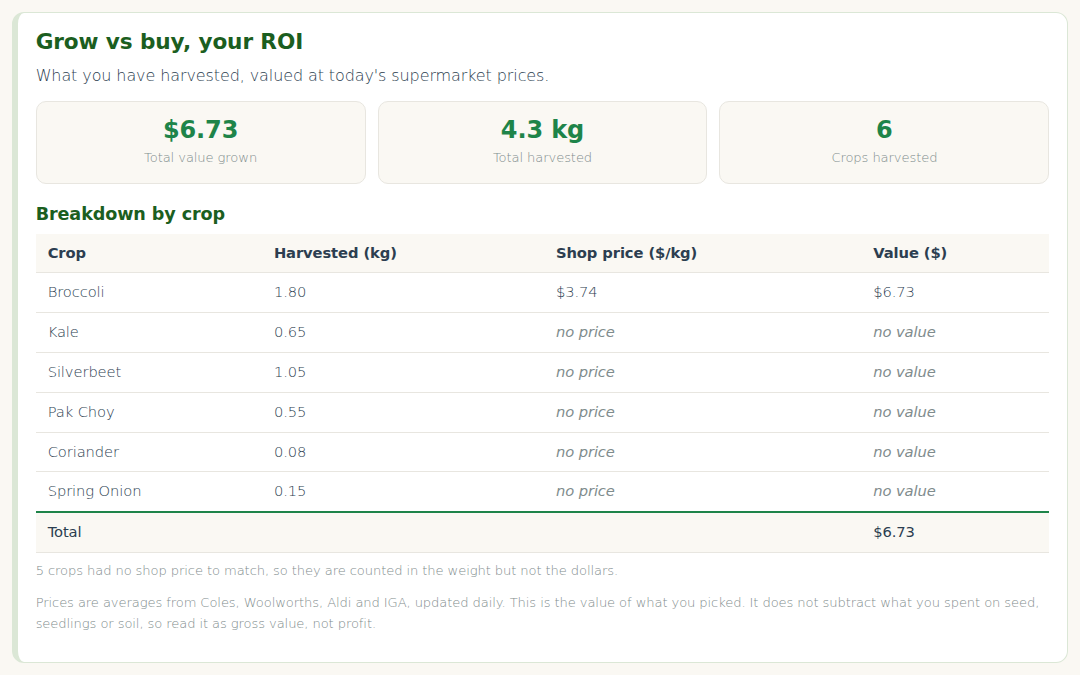
Grow vs buy, your ROI, tells you in dollars what your garden has produced. It sits at the bottom of the garden journal on /my-garden/ and moves every time you log a harvest. Real weight from your own beds, valued at today’s supermarket prices.
 Your real weights, valued at today’s supermarket prices. No estimates, no padding.
Where to find it
Open /my-garden/ and scroll past your beds, your active plantings and your recent harvests. Grow vs buy, your ROI is the next panel down, just above Pro tools.
Nothing to switch on and nothing to run. It reads your harvest log every time the page loads.
How the number is worked out
One line of arithmetic per crop:
Then every crop is added together for the total.
Two details behind that:
- Everything becomes kilograms first. Grams are divided by a thousand. Bunches, heads and fruits use an average per item, set out in Log a harvest. Log in kg or g where you can and the figure gets sharper.
- The price is today’s, not the price on the day you picked. The feed is rebuilt daily from Coles, Woolworths, Aldi and IGA. So your total drifts a little as prices move, even in a week you harvest nothing. That is intended, it answers “what would this lot cost me at the shops right now”.
The three headline numbers
| Number | What it means |
|---|---|
| Total value grown | Every crop’s weight times its shop price, added up. The headline dollar figure. |
| Total harvested | Total weight in kilograms, including crops that have no price to value them against. So this can climb while the dollar figure sits still. |
| Crops harvested | How many different crops you have picked at least once. A spread measure, not a size one. |
The breakdown by crop
Under the headline numbers, one row per crop, sorted with the most valuable first. Four columns: the crop, kilograms harvested, the shop price per kilogram used, and the value that produced.
The top row is the useful one. It is the crop currently earning its space.
On the free plan you get the three headline numbers and not the breakdown. Starter and Pro show the full table.
Why some crops show no price
Some rows say no price in the price column and a dash in the value column. The crop is still counted in your total weight, just not in your dollars.
That happens because the price feed does not carry a price for everything. Of the crops it tracks, well under half currently have a live supermarket price. Herbs and the less common vegetables are the usual gaps, and shops simply do not list them consistently enough to average.
The panel tells you how many crops it could not price, so you always know how much of your garden is missing from the dollar figure. Showing a guessed price would make the number look better and mean less.
What the number is not
Nothing is subtracted. Not seed, not seedlings, not potting mix, not fertiliser, not water, not the bed you built. This is the value of what you picked, full stop. Anyone telling you otherwise is reading an older version of this page.
Shop prices are averages. Across four retailers, and they move week to week. Your local may be dearer or cheaper on the day.
Unweighed picks are estimates. Anything logged in bunches, heads or fruits uses an average item weight, so it carries whatever error that average has.
It cannot see what you did not log. The most common reason an ROI looks disappointing is unlogged handfuls, not a bad garden.
Removing a plant costs you its dollars. Harvests keep no copy of the crop name, so deleting the plant turns them into Unknown, which has no price. The weight stays, the value goes. Set finished plants to Harvested with Edit instead of removing them. This is the one thing most likely to make your total drop for no good reason.
What it is actually good for
- Deciding what to plant more of. The per crop table settles arguments. Whatever sits at the top is worth another bed.
- Deciding what to stop growing. A crop that took a whole season and a lot of water to return a few dollars is telling you something, especially when it is cheap in the shops anyway.
- Seeing the subscription pay for itself, or not. The figure is right there. Compare it to what you pay and judge for yourself.
- Keeping going in winter. When the beds look bare, the running total is the reminder that the year added up.