

User guide · running your garden · 5 min read
This is the entry that pays you back.
This is the one entry that pays you back. Everything else in the journal is record keeping. Harvest weight is what turns into a dollar figure, so a garden with no harvests logged has an ROI of zero no matter how well it grew.
 No harvests logged means an ROI of zero, however well the garden actually grew.
Why logging every pick matters
Two handfuls of silverbeet on a Tuesday feels too small to bother with. Log it anyway. A garden gives you its yield in small handfuls, not in one big weigh in, and the small ones are most of the total. Skip them and your ROI reads far lower than the truth.
It also fixes the memory problem. In March you will not recall what the front bed gave you in August, but the log will.
How to log one
On /my-garden/, in the button row at the top of Your garden, click Log a harvest. The form opens underneath.
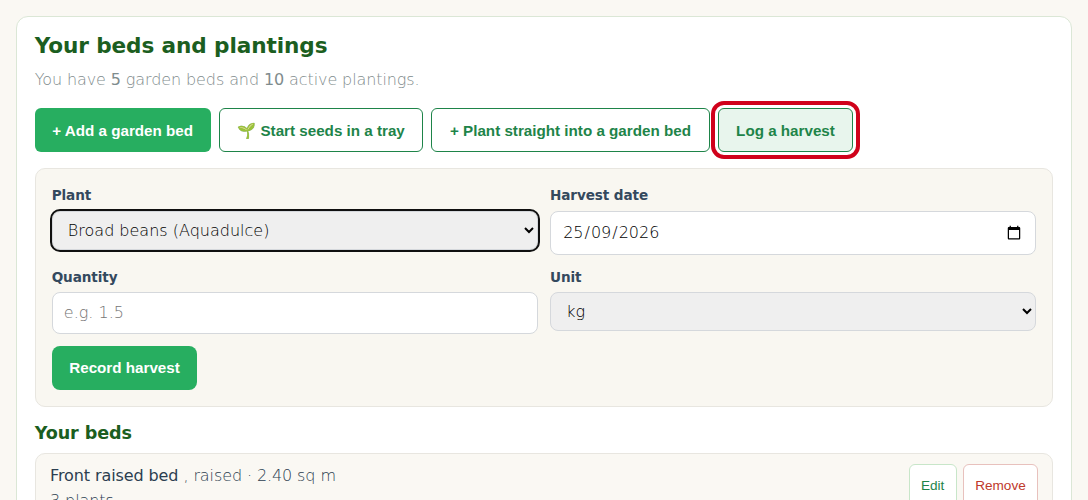
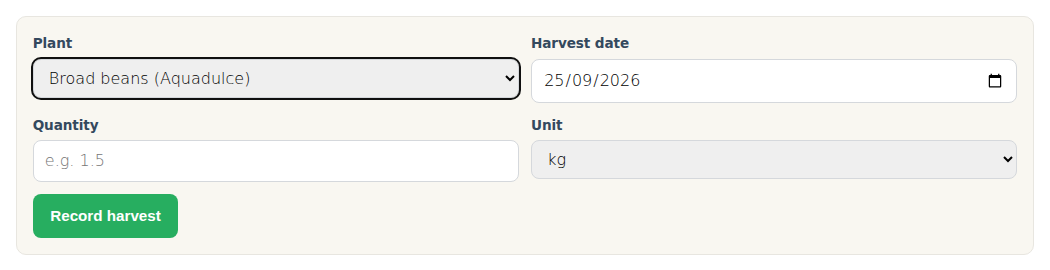
| Field | Required? | Notes |
|---|---|---|
| Plant | Yes | Dropdown of your active plants, shown as crop plus variety, so “Tomato (Roma)” and “Tomato (Cherry)” stay apart. |
| Harvest date | Yes, defaults to today | Back date it if you picked on the weekend and are logging on Monday. |
| Quantity | Yes | Decimals are fine. 0.35 is a normal entry. |
| Unit | Yes, defaults to kg | kg, g, bunches, heads or fruits. See below, this one matters more than it looks. |
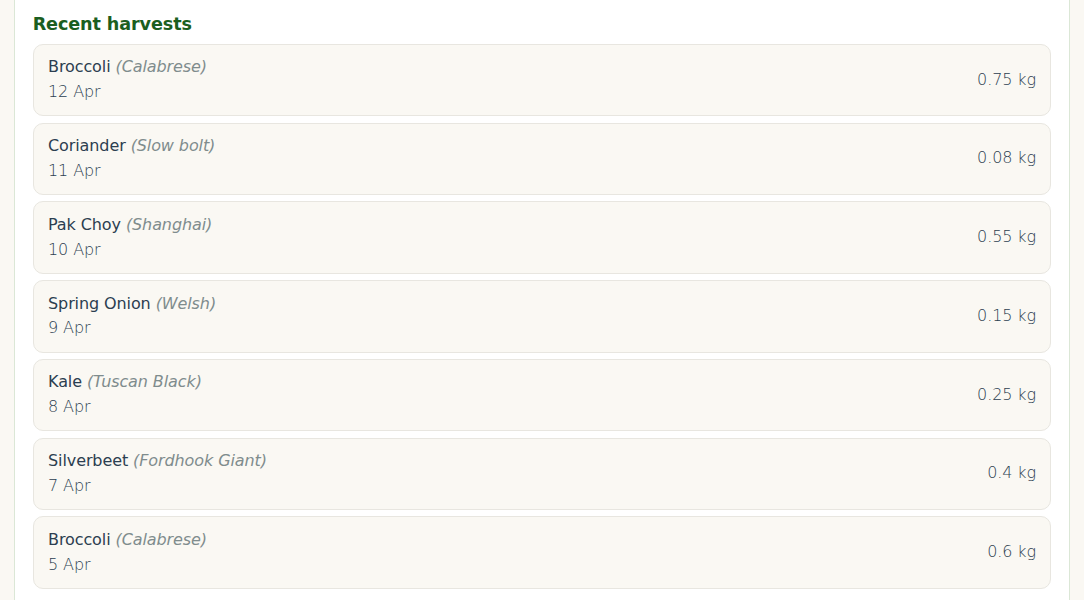
Press Record harvest. It shows up under Recent harvests and the ROI figures move immediately.
Picking the right unit
Shop prices are per kilogram, so anything you log has to become kilograms before it can be valued. Weight units are exact. The counting units use an average per item:
| Unit | Counted as | Best for |
|---|---|---|
| kg | Exactly what you type | Anything you can put on scales. The most accurate option. |
| g | Divided by 1,000 | Herbs and small picks. 80 g of coriander. |
| bunches | 0.25 kg each | Silverbeet, kale, herbs picked by the handful. |
| heads | 0.5 kg each | Broccoli, cabbage, lettuce, cauliflower. |
| fruits | 0.15 kg each | Tomatoes, capsicums, cucumbers, zucchini. |
The averages above are close enough for most picks, but they are still averages. One of your cabbages might be twice the weight of the assumed half kilo. If the crop matters to you, weigh it, and your ROI stops being an estimate.
Weighing without a fuss
- Kitchen scales at the back door beat kitchen scales in the kitchen. The pick gets weighed if the scales are where you walk in.
- Weigh the bowl once, note it, subtract it every time. Or tare it, if your scales do that.
- Weigh before you trim. Shop price is for the vegetable as sold, roots and outer leaves and all, so trimming first undercounts you.
- One entry per pick per crop. Do not add up a week in your head, you will round it wrong.
What it feeds
- Harvest history, every entry, newest first, and downloadable as CSV on Pro.
- Grow vs buy, your ROI, at the bottom of the garden journal. Weight times today’s shop price.
- Your running totals per crop, which is what tells you the thing worth knowing, that one bed earns its space and another does not.
Removing a plant deletes the plant record, and your harvests keep no copy of the crop name. They stay in your history and they still count towards your total weight, but they turn into Unknown and stop being valued in dollars. On a small garden that can take most of your ROI with it.
When something is finished, click Edit on the plant and set the growth stage to Harvested. The plant stays, the crop name stays, and every dollar you have earned stays counted. Use Remove only for a record you created by mistake and never harvested from.
Common mistakes
Logging in grams but leaving the unit on kg. Type 350, leave it on kg, and you have just recorded 350 kilograms of beans. Check the unit before you save, it defaults to kg every time.
Saving up a whole season and entering it in one go. You will guess, and you will guess low.
Not logging the small ones. The small ones are the bulk of the total.
Logging against the wrong plant when you grow two varieties. Read the variety in brackets in the dropdown. It is there for this.