
Walk into any supermarket in Queensland and you will not find a mulberry. Not in season, not out of season, not ever. It is not that nobody wants them. It is that a ripe mulberry has the structural integrity of a wet tissue and starts leaking the moment it leaves the branch. A commercial supply chain cannot move that. So the only way to eat a proper mulberry is to grow one, or to know somebody who does.
That is a genuinely unusual position for a fruit. Almost everything else in the garden is a nicer version of something you can buy. Mulberries are a category of their own, and the tree is one of the least demanding things you can put in the ground here. The catch is that most people pick them at the wrong moment, prune them at the wrong time of year, and plant them in the wrong spot. All three are fixable, and all three are worth getting right.
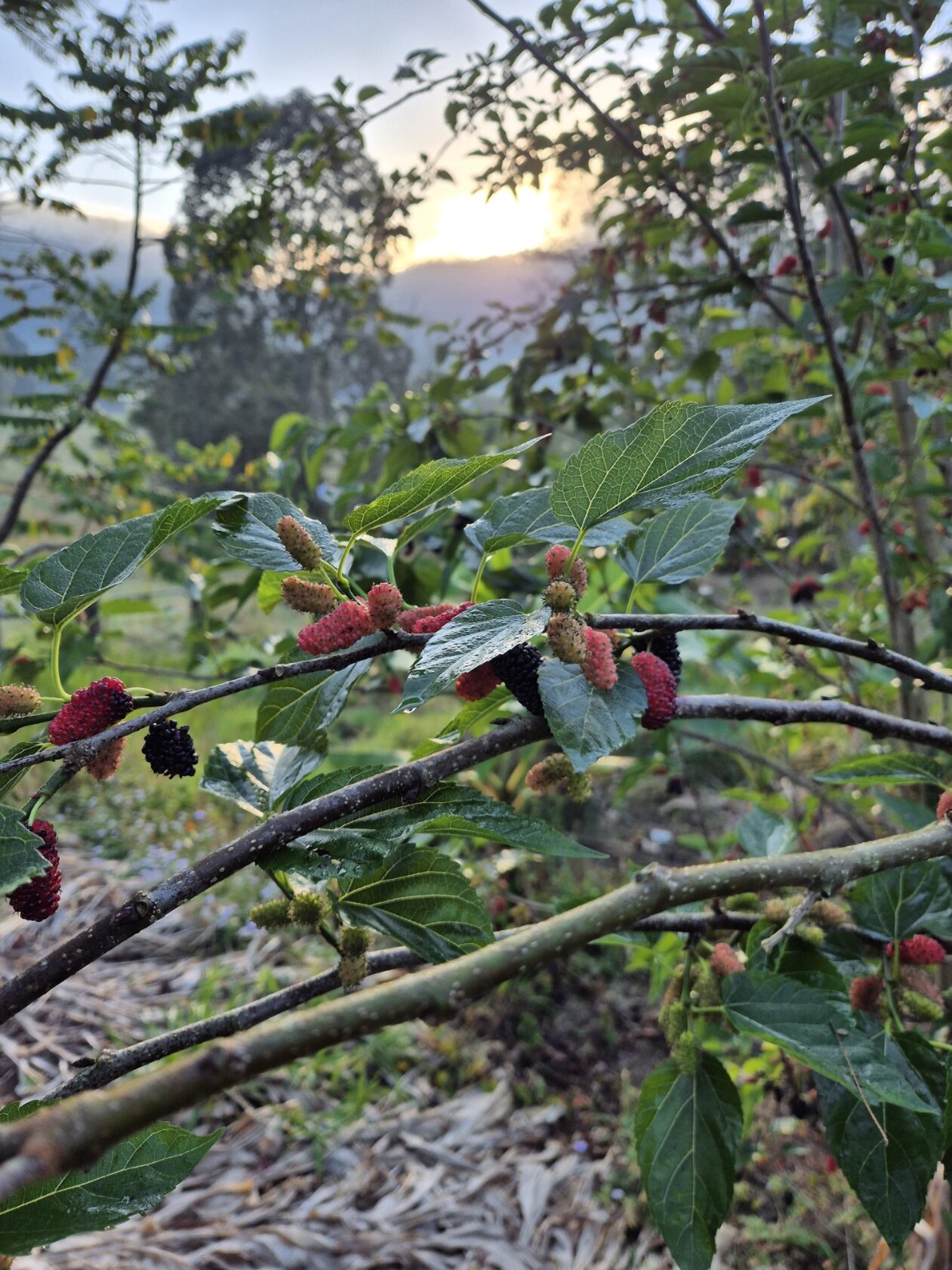
What you are actually growing
Mulberries belong to the genus Morus, and the ones you will meet in an Australian garden come from four species. Morus alba, the white mulberry, is the most cold hardy and the one grown for silkworm leaf. Morus nigra, the black mulberry, has the deepest flavour and the shortest, most concentrated season. Morus rubra is the American red mulberry. Morus macroura gives you the Shahtoot types with the very long fruit.
In practice, most Australian nurseries sell a handful of named varieties rather than straight species. Black English is the sweeter, later one with a short and very heavy season. Hicks Fancy carries smaller fruit over a much longer window on a more manageable tree, which is why it turns up in a lot of suburban backyards. Shahtoot produces those long fruit on a genuinely small tree, and there is a white fruited form of it that does not stain, which matters more than you would think if the tree is anywhere near a path.
Mulberry varieties get swapped over back fences as cuttings for generations, and the label falls off somewhere around the second handover. If you inherited your tree, or grew it from a cutting somebody gave you, treat the variety name as a rumour. What matters for growing it is fruit length, season length and tree size, all of which you can observe directly.
The ripeness test, and why most people get it wrong
This is the single most useful thing in this article, so here it is up front. Red is not ripe. A red mulberry is a mulberry that is roughly three quarters of the way there, and it tastes sharp and slightly green. The colour keeps going after red, through to a deep purple that is close to black.

Colour alone is not quite enough, because a fruit can darken while still holding on tight. Add the second test, which is the one that actually decides it. Cup the fruit and lift gently. A ripe mulberry releases into your hand with no pull at all. If you have to tug, even slightly, it is not ready, and you have just wasted a fruit that would have been perfect in two days.
The reason this matters so much with mulberries, and matters far less with something like a banana or an avocado, is that mulberries are non climacteric. They have no post harvest ripening burst. A banana picked green will finish ripening on your bench because the fruit itself generates a surge of ethylene that drives the process. A mulberry does not do that. Whatever sugar, colour and softness it has at the moment you detach it is what you are going to eat. There is no bowl on the windowsill that fixes an underripe mulberry.
Check the colour
Deep purple, close to black, all the way to the stem end. Red means wait.
Cup and lift
No tug. If it resists at all, leave it. Ripe fruit falls into your palm.
Or use a sheet
Old sheet or tarp under the tree, shake the branch gently. Only ripe fruit lets go.
The sheet method is how you harvest a mature tree without spending your whole morning up a ladder. Lay a clean sheet or a tarp out under the canopy, take a branch, and shake it once, gently. Ripe fruit drops. Underripe fruit stays put. The tree has effectively sorted the crop for you, which is a rare piece of good fortune in gardening.

The health case, stated honestly
Mulberries do genuinely well on the numbers, and it is worth separating what the data supports from what gets claimed. Here is the USDA composition for raw mulberry, per 100 grams, with two familiar berries alongside for scale.
| Per 100 g raw | Mulberry | Blueberry |
|---|---|---|
| Energy | 43 kcal | 57 kcal |
| Water | 87.7 g | 84.2 g |
| Protein | 1.44 g | 0.74 g |
| Fibre | 1.7 g | 2.4 g |
| Sugars | 8.1 g | 9.96 g |
| Vitamin C | 36.4 mg | 9.7 mg |
| Iron | 1.85 mg | 0.28 mg |
| Potassium | 194 mg | 77 mg |
| Calcium | 39 mg | 6 mg |
| Magnesium | 18 mg | 6 mg |
| Vitamin K | 7.8 µg | 19.3 µg |
Two figures stand out and they are both real. Vitamin C at 36.4 mg per 100 g is close to four times a blueberry, and iron at 1.85 mg is roughly six times. That iron number is genuinely high for a fruit. It is non haem iron, so it is absorbed less efficiently than iron from meat, but the vitamin C sitting in the same mouthful helps with exactly that, which is a pleasant coincidence rather than anything anyone designed.
The dark colour comes from anthocyanins, mainly cyanidin 3 glucoside and cyanidin 3 rutinoside. These are the same class of pigment that colours blackcurrants and elderberries. Worth knowing: white mulberries contain no anthocyanins at all. If you are growing a white fruited variety for the non staining convenience, you are trading away the pigment chemistry that people cite when they call mulberries a superfood.
You will see mulberry sold as a blood sugar treatment. The compound behind that claim is 1 deoxynojirimycin, or DNJ, and it is real. It inhibits intestinal alpha glucosidase, the same enzyme target as the diabetes drug acarbose, which slows the breakdown of starch into glucose. Two things are usually left out. First, DNJ is concentrated in the leaves, not the fruit, so eating mulberries is not the intervention being studied. Second, the trial evidence is genuinely mixed. Meta analysis does show significant reductions in glucose and insulin after a meal, but with substantial heterogeneity between studies, and the effect is short lived because DNJ has low bioavailability and clears quickly. It is a real pharmacological effect on a modest scale, not a treatment. If you are on diabetes medication, mulberry leaf tea is not a free addition, because you are stacking two things that act on the same enzyme. Talk to your doctor first. Expect the same gut side effects that acarbose produces, for the same reason.
Flowering, and why your trees are not in step

Mulberry flowers are easy to miss entirely, because they are not flowers in the way most people picture them. There are no petals worth the name. What you get is a short green catkin, wind pollinated, doing its job without any need to advertise to insects. If you have never noticed your mulberry flowering, that is why.
What is worth paying attention to is the gap between trees. The tree above was still flowering on 3 September while trees a short distance away were being picked on 5 September. That spread is not a fault. It is the most useful thing a mixed planting gives you, because it stretches a short and concentrated harvest into something you can actually keep up with. A single Black English will hand you the entire crop over about a fortnight and dare you to deal with it. Two or three trees flowering out of step, or one Black English plus one Hicks Fancy, turns that fortnight into a couple of months.
You do not need a pollination partner for fruit. Most mulberry varieties set fruit without one, and many are parthenocarpic, meaning they will fruit without pollination at all. So plant a second tree for season length, not for pollination.
Where to plant one, and where absolutely not to
Mulberries are close to unkillable once established, which is the good news and also the problem. They want full sun, they will accept almost any soil that is not waterlogged, and they tolerate a much wider pH range than most fruit trees. They handle our heat, they handle a dry spell, and they will fruit heavily on rainfall alone in a normal Dayboro season. In terms of what the tree needs from you, the honest answer is very little.
Do not plant a mulberry near pipes, paths or a septic system
Mulberry roots are vigorous, shallow and wide, and they will lift a concrete path, crack a slab edge and get into drainage. This is the single most common regret people have about their mulberry, and it usually arrives about fifteen years after planting, when moving the tree is no longer a conversation.
One nuance worth getting right, because the folklore overstates it. Roots do not drill into intact pipe. They cannot. What actually happens is that a pipe with a hairline crack or a bad joint leaks a little moisture into the surrounding soil, roots find that moisture, follow it to the source, enter through the existing fault, and then expand until the fault becomes a blockage. The root did not cause the failure. It found one and made it worse. That distinction matters when you are deciding where to plant, because it means the real question is not whether your pipes are strong but whether they are old.
Practical rule: keep a mature mulberry a minimum of 8 to 10 metres from any drainage line, septic trench, path or slab. In a paddock or an open corner of the block, plant whatever you like. Near infrastructure, choose a Shahtoot or a Hicks Fancy on a smaller frame and keep it pruned hard.
The other siting consideration is staining. Birds eat mulberries, birds then sit on things, and the result is permanent on light coloured render, pavers and car duco. Do not plant a dark fruited mulberry where you park, where you hang washing, or over a light coloured path. This is not a small inconvenience, it is a decade of annoyance.
Feeding and watering
A mulberry is not a hungry tree by fruit tree standards, and overfeeding one is a real and common mistake. Too much nitrogen gives you an enormous canopy of beautiful leaves and a disappointing crop, and on a tree that is already vigorous you are simply creating more pruning work for yourself.
A sensible program for an established tree in our conditions is one feed in early spring as the buds break, using a balanced complete fertiliser or well rotted manure spread out to the dripline, and a second lighter one after harvest to help the tree rebuild for next season. That is it. Do not feed heading into winter. Skip the spring feed entirely if last season’s growth was more than about 600 mm on the leaders, because that tree is telling you it has plenty of nitrogen already.
Mulch matters more than fertiliser here. The feeder roots are shallow, so they are the first thing to suffer in a hot dry spell and the first thing damaged if you cultivate under the tree. A thick straw or hay mulch out to the dripline, kept off the trunk itself, protects those roots, holds moisture and feeds the tree slowly as it breaks down. You can see exactly this in the photographs above.
On water, an established mulberry will survive on rainfall. But there is one window where watering genuinely changes the outcome, and that is from fruit set through to harvest. A tree that goes dry while the fruit is sizing gives you smaller, seedier, less juicy mulberries, and it will drop a proportion of the crop outright. If we get a dry patch in August or September, a deep soak once a week through the fruiting window is the highest value water you will put on anything in the garden.
Pruning, and the timing mistake that damages trees
Start with the fact that makes mulberry pruning easy: mulberries fruit on the current season’s growth. That means pruning does not cost you next year’s crop the way it does on a tree that fruits on old wood. You can cut a mulberry hard and it will fruit on what it regrows. This is the whole reason a mulberry can be kept to a size you can actually pick from, rather than becoming a 10 metre tree that feeds the birds and nobody else.
Given that, the sensible approach for a home tree is to keep it low and open. Take out anything dead, crossing or heading into the middle, then shorten the leaders to hold the tree at a height you can reach from the ground or a short ladder. If you inherited a tree that is already too tall, you can bring it down over two or three seasons rather than all at once, which reduces the shock and the flush of water shoots.
Prune in full dormancy, not late winter
This is where people damage mulberries without realising. The window is full dormancy, between leaf fall and mid winter. Not late winter, and not as the buds are starting to move.
The reason is root pressure. As the tree comes out of dormancy, the roots begin pushing sap up through the xylem under real pressure, before the leaves have opened to draw it. Cut into that and the wound bleeds heavily and will not callus over, because the tissue cannot dry enough to seal. You end up with a permanently weeping cut that is an open invitation to bacterial infection. On a big limb this can be the beginning of the end for that limb.
A light shaping cut straight after harvest is fine and does not cause this, because the tree is in full leaf and transpiring hard. It is the late winter cut that does the damage. If you have missed the dormant window, wait until after the fruit rather than pushing on.
Propagation, which is almost too easy
Mulberries strike from hardwood cuttings about as readily as anything you will ever propagate, which is exactly why they get passed around back fences. Take cuttings during the dormant pruning, since you are cutting the wood off anyway. Use pencil thick wood from the last season’s growth, cut lengths of roughly 200 to 300 mm with three or four buds, cut square at the base and angled at the top so you can tell which way up it goes when you come back to it later.
Push them two thirds deep into a free draining mix, keep them somewhere sheltered and just moist, and be patient. Strike rates on Morus alba types are very high. Morus nigra is noticeably harder and less reliable, so take more cuttings than you need. A struck cutting comes true to the parent, which is the other advantage: seed grown mulberries are a genetic lottery and can take many years to fruit, while a cutting is a copy of a tree you have already tasted.
Pests, in order of how much they will actually cost you
Birds are number one and it is not close. A flock will strip a tree in days, and they are working the same ripeness signal you are, so they arrive precisely when the fruit becomes worth eating. For a small or moderate tree, throwing a proper net over the whole canopy before the fruit starts colouring is the only thing that genuinely works. Use white knitted netting with an aperture of 5 mm or less, secured at the trunk. Loose black bird netting with a wide mesh is a wildlife hazard, because flying foxes, birds and snakes get tangled in it, and in several Australian states it is no longer permitted. For a large mature tree, netting stops being realistic and the honest answer is that you plant enough tree to share.
Queensland fruit fly is the one people underestimate. Bactrocera tryoni treats mulberry as a genuine host, and black mulberry is a good one from its point of view. In our part of the world Qfly is endemic, not an occasional visitor, so this is a management problem rather than a surprise. Exclusion netting fine enough to keep out fruit fly is the reliable control, and it has the pleasant side effect of dealing with the birds at the same time. Traps and baits help reduce pressure but will not protect a crop on their own. Never leave fallen fruit lying under the tree, because that is a breeding site you are maintaining for next season. Bag it and bin it, or solarise it in a sealed bag in the sun. Do not compost fruit fly affected fruit in an open heap.
Beyond those two, mulberries are remarkably trouble free. There is a fungal condition called popcorn disease, caused by Ciboria carunculoides, which infects at flowering and swells individual carpels into hard pale lumps so the fruit ends up looking like popcorn. It is reported mainly on white mulberry types overseas. I have not been able to confirm established Australian records for it, so treat that one as something to recognise if you ever see it rather than something to expect.
Harvest, and then the real problem
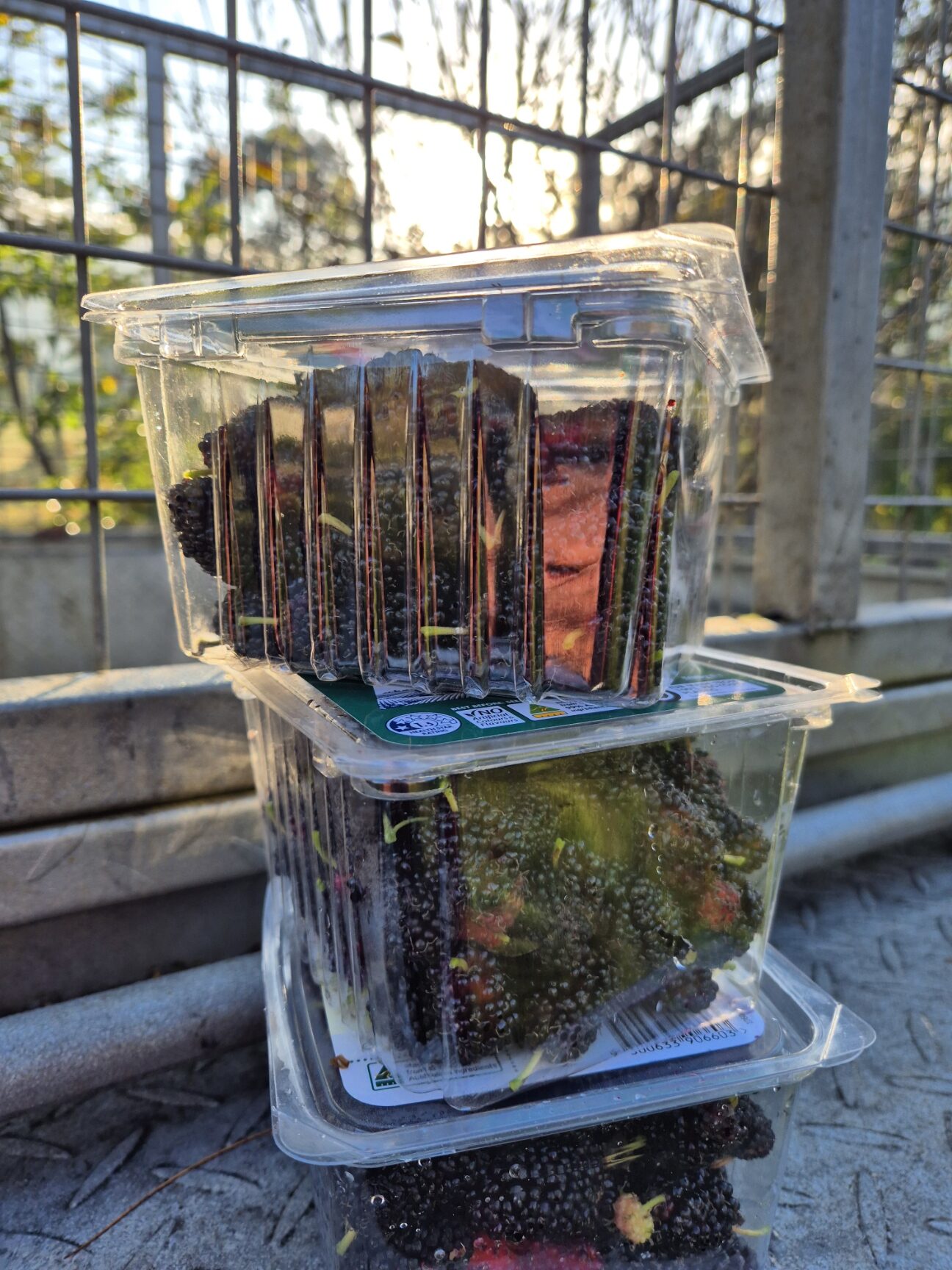
Pick into shallow containers. This is not fussiness. A ripe mulberry has almost no structural strength, and the weight of fruit above will crush the fruit below within minutes. Punnets, shallow trays or a single layer in a flat basket. Never a bucket.
Do not wash them until you are ready to use them. Wet mulberries collapse and go mouldy fast. Unwashed, in a single layer in the fridge, you have about two or three days. Washed, you have hours. That short window is the entire reason this fruit does not exist commercially, and it is why the preserving decision needs to be made on the same day you pick.
Freezing, which is the best answer
Spread them in a single layer on a tray, unwashed, and freeze them solid before bagging. If you bag them wet or in a heap you get one large purple brick. Frozen individually they pour like beads and you can take out a handful at a time. They keep about twelve months and come out of the freezer perfectly good for cooking, smoothies and sauce, though like any berry they are soft when thawed and are not going to look like fresh fruit.
Jam, with one important adjustment
Mulberries are low in both acid and pectin, which is a difficult combination for jam because those are the two things that make a jam set. A straight mulberry jam with just fruit and sugar will usually give you syrup. The fix is to add acid and pectin from another source. Lemon juice supplies the acid, roughly the juice of one to two lemons per kilogram of fruit. For pectin you can either add commercial pectin, or use green apple, or simply throw in a proportion of your underripe red mulberries, which carry more pectin than the fully ripe ones. That last option has the advantage of using up the fruit you knocked off by accident.
Drying
Dried mulberries are excellent and the process is uncomplicated. A dehydrator at around 55 to 60°C, or the lowest setting your oven will hold with the door cracked. They take a long time because of the high water content, so allow the best part of a day. They finish sweet, chewy and slightly caramel, and they store for months in an airtight jar.
Mulberry stain is anthocyanin plus fruit sugar and protein. Hot water sets the protein into the fabric and makes the stain permanent, which is precisely the opposite of what everyone instinctively does. Rinse from the back of the fabric with cold water first, as soon as you can, then treat and wash normally. The old bush remedy of rubbing the stain with unripe green mulberries genuinely does help, because the underripe fruit carries enzymes and acids that break down the pigment. It is a strange piece of folklore that turns out to have a mechanism behind it.
What not to eat, and what not to get on your skin
Unripe fruit. Green and white stage mulberries are not just unpleasant, they cause stomach upset and can produce nervous system stimulation. There are documented reports of hallucinations from eating quantities of unripe fruit. This is worth knowing if you have children who help with the picking, because a small person working through a handful of green ones is a plausible scenario.
The sap. Every part of the plant except the ripe fruit contains a milky white latex. It is toxic if ingested and it is a skin irritant. Most people never react to it, but if you are pruning a large tree you are going to get sap on your hands and forearms, so wear long sleeves and gloves and do not rub your eyes. Some people are sensitised to it and get a proper contact dermatitis.
Ripe fruit is completely safe and always has been. The warnings apply to the unripe fruit and to the vegetative parts of the plant, not to what you are picking.
The leaves are not waste
If you prune a mature mulberry you will generate a startling volume of leaf, and it is worth knowing that this material has real value. Mulberry leaf is high quality livestock fodder, with a protein content that compares well with lucerne, and cattle, sheep, goats and poultry all take it readily. On a small block, feeding out mulberry prunings is a genuine feed source rather than a token gesture.
It is also, famously, the only thing silkworms will eat, specifically Morus alba leaf. If there are children in the house who have come home from school with silkworm eggs, a white mulberry in the yard changes that project from a scramble to a non event.
Why bother
The argument for a mulberry is not that it is the best fruit in the garden. It is that it is the fruit with the largest gap between what you can grow and what you can obtain any other way. An avocado from your own tree is better than a shop one. A mulberry from your own tree is the only mulberry you are ever going to eat.
On top of that, it asks less of you than almost anything else that produces fruit. It does not need a pollination partner. It does not need spraying. It does not need much feeding. It handles our heat and our dry spells. It will fruit within two or three years from a struck cutting, and it will keep doing it for decades with nothing more than a dormant prune and a net. Set against a citrus or a stone fruit, the effort to reward ratio is not really a contest.
The short version
Red is not ripe, wait for deep purple and no tug. Mulberries do not ripen after picking, so there is no second chance on a fruit you took early. Plant well away from pipes, paths and anything light coloured. Prune in full dormancy between leaf fall and mid winter, never in late winter. Net before the fruit colours, both for birds and for Queensland fruit fly. Pick into shallow punnets, do not wash until you use them, and freeze on a tray in a single layer the same day. Feed lightly, mulch heavily, and water deeply through the fruiting window. Do not eat the green ones.
Garden Buddy, subtropical growing at Dayboro, QLD.

