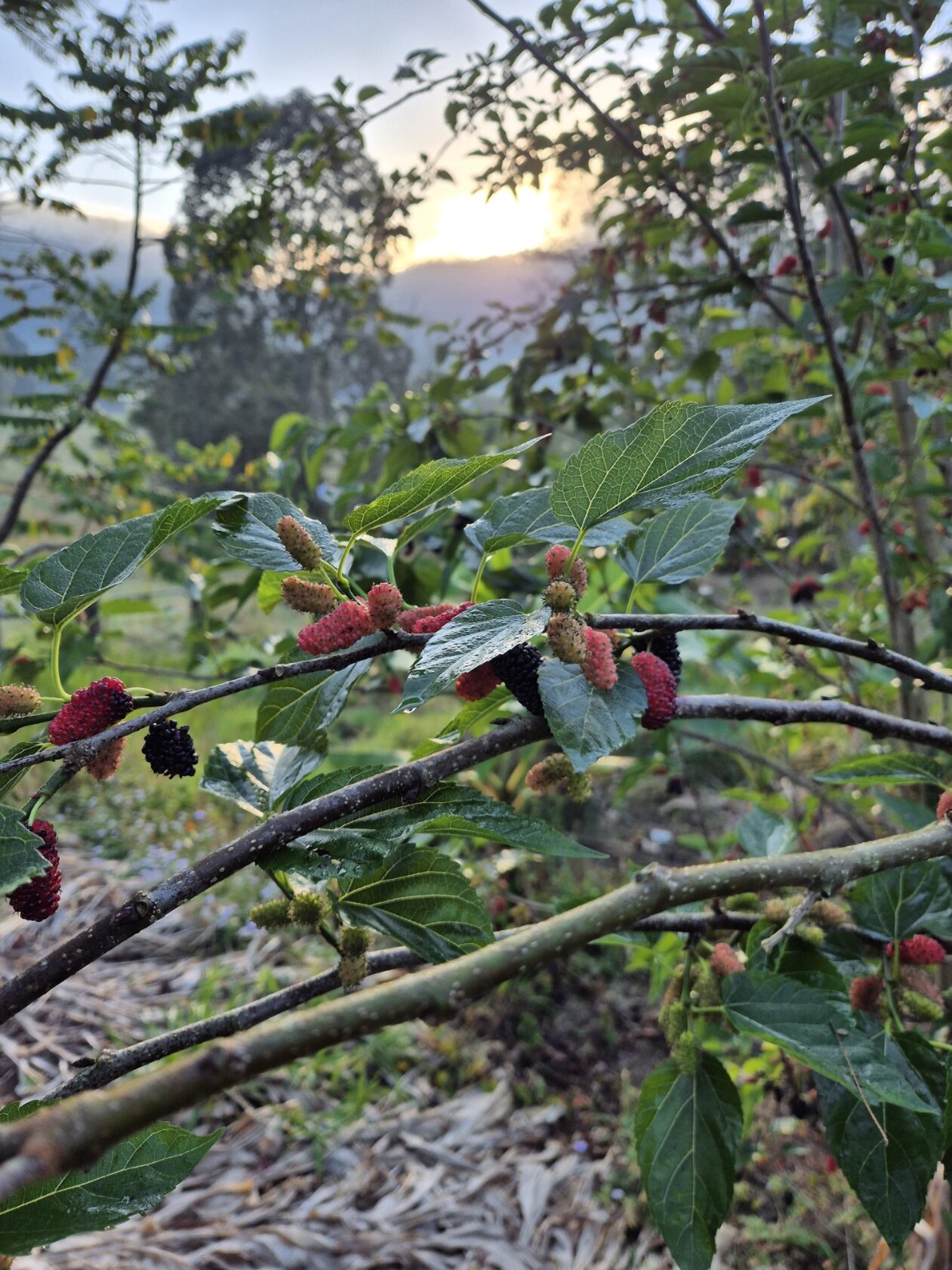
Both avocado trees went into flower in the last fortnight and the whole canopy has gone from dark green to a haze of yellow green. That is the picture below, taken on a still September morning. It looks like nothing much is happening. In fact this is the single most important two months of the avocado year, and the reason there are two different trees standing side by side instead of one.

The strangest flower in the orchard
An avocado flower is perfect, meaning it carries both male and female parts. It should be able to pollinate itself. It goes to remarkable lengths not to.
Each flower opens twice. The first opening is functionally female: the stigma is white and receptive, and the anthers have not released any pollen. The flower then closes. The following day it reopens as a functional male: the anthers split and shed pollen, and the stigma is no longer receptive. Botanists call this synchronous protogynous dichogamy, which is a mouthful for a simple idea. The tree is trying very hard to be pollinated by a different tree.
What makes it useful to a gardener is that avocado cultivars split into exactly two camps depending on which half of the day they do each job.
| Flowering type | Day 1 | Day 2 |
|---|---|---|
| Type A Hass, Reed, Pinkerton, Wurtz |
Opens in the morning as a female, closes around midday | Reopens in the afternoon as a male, sheds pollen |
| Type B Shepard, Fuerte, Sharwil, Bacon, Zutano |
Opens in the afternoon as a female, closes in the evening | Reopens the next morning as a male, sheds pollen |
Shepard is Type B. Hass is Type A. That is the whole trick.
Read the two rows together and you get this:
Every morning, the Hass is open and receptive as a female, while the Shepard is shedding pollen. A bee moving between them carries Shepard pollen onto a receptive Hass stigma.
Every afternoon, it reverses. The Shepard is receptive, the Hass is shedding. The same bee carries Hass pollen back the other way.
So a Type A and a Type B planted within bee range of each other pollinate one another twice a day, all through the flowering window. Neither can do that alone. If both trees were Hass, both would be female at the same moment and male at the same moment, and the pollen would consistently arrive when nothing was ready to receive it.
A lone avocado tree does still set fruit. The neat two day clock above is a laboratory description, and in real weather it runs sloppy. When daytime temperatures sit below about 20 °C the cycle slows and the male and female stages start to overlap on the same tree, which allows a certain amount of self pollination. What a matched A and B pair buys you is not the difference between fruit and no fruit. It is yield and consistency. Research on Shepard and Maluma blocks found that as trees sat further from a cross pollinating partner, the rate of outcrossing fell and both yield and fruit quality fell with it. Two trees, close together, is simply the best version of this.

What those drooping leaves are telling you
In the second photo the leaves hang down and curl in along their length, and a few carry brown along the tip and edge. That is worth diagnosing properly rather than guessing, because the two most likely causes call for opposite responses.
- Water stress. A flowering avocado is running its highest water demand of the year, and September is the dry end of the season here. Leaves roll to cut the surface area losing moisture. Test for it the boring way: dig a small hole about 100 to 150 mm deep under the canopy, take a handful of soil and squeeze. If it holds together and darkens your palm, moisture is fine and the droop is something else. If it crumbles dry, that is your answer.
- Chloride or salt burn. Avocado is one of the most chloride sensitive tree crops grown. Salt accumulates at the leaf tip and margin, where it kills tissue and leaves a distinct dry brown edge with a yellow halo, most often on older leaves first. The usual sources are salty irrigation water, muriate of potash fertiliser, or heavy raw poultry manure near the trunk. The diagnostic difference is that water stress affects the whole canopy at once and recovers overnight, while salt burn is progressive, concentrated at leaf tips and does not recover.
If the browning sits neatly along tips and margins on older leaves, stop using any chloride fertiliser immediately and leach the root zone with a long, slow, deep watering of clean water. If the whole tree simply looks slack in the afternoon and perks up by morning, that is normal transpiration and not a problem.
Why bother growing your own
There is one reason that stands above all the others, and it is not the obvious one.
You control maturity. Commercial fruit is picked at the industry minimum dry matter, because dry matter climbs slowly and every extra week on the tree is a week of risk to the grower. The Australian standard is 23 percent dry matter for Hass and 21 percent for Shepard. Those are minimums, set as the floor for acceptable eating quality. Consumer testing behind that 23 percent figure found that up to 70 percent of people preferred a 26 percent Hass over a 22 percent one. A backyard tree lets you leave the fruit hanging until it is well past the minimum, and the difference in flavour and texture is not subtle.
The tree is the storage. This is the peculiar and wonderful thing about avocados. The fruit does not ripen on the tree. It holds, hard and green, accumulating oil, and only begins to soften once you pick it. So the tree acts as a living pantry with a window several months wide, and you pick two or three at a time as you need them. No other fruit tree in a subtropical backyard behaves like that.
Two varieties stretch the season. Shepard fruit matures ahead of Hass. Commercially Shepard runs roughly February to May and Hass from about May onward. Shift those windows for a home tree in a cool valley and confirm them by testing rather than by calendar, but the principle holds: the pair gives you a longer run than either alone.
And the honest cost side. A grafted avocado takes three to five years to crop, gets big, casts heavy shade, and dies of root rot if you put it in the wrong spot. It is a serious, long commitment, not a quick win.
The health case, with the disappointing bit included
Avocado is genuinely nutrient dense, and the numbers are solid. Per 100 g of flesh, roughly half a medium fruit, you get about 485 mg of potassium, about 6.7 g of dietary fibre, and around 15 g of fat that is mostly oleic acid, the same monounsaturated fat that dominates olive oil. On top of that sit folate, vitamin K, vitamin E, and the carotenoids lutein and zeaxanthin, which concentrate in the macula of the eye.
There is a neat second order effect worth knowing. Carotenoids are fat soluble, so your body absorbs very little of the beta carotene and lutein in a plain salad. Add avocado and the fat carries them across. You get more out of the tomato and the carrot sitting next to it, which is a real, measured effect rather than a marketing line.
The largest trial run on this question was the Habitual Diet and Avocado Trial, published in the Journal of the American Heart Association in 2022. It put 1,008 adults with elevated waist circumference on either one avocado a day for six months or their usual diet, and measured belly fat directly by MRI. The primary result was flat. There was no significant difference in visceral fat between the two groups, and no significant difference in liver fat, inflammation markers or the components of metabolic syndrome. What it did find was a modest reduction in total and LDL cholesterol in the avocado group.
Read that as it stands. An avocado a day is a good food that nudges your cholesterol in the right direction. It is not a fat loss treatment, and anyone selling it as one is ahead of the data. It is also energy dense, around 160 calories per 100 g, so a whole large fruit is a substantial addition to a day rather than a free one.
Planting: get the drainage right or nothing else matters
Almost every dead backyard avocado in this district died of the same thing, and it is worth naming before anything else. Phytophthora cinnamomi, avocado root rot, is a water mould. It needs warm, wet soil to produce the swimming spores that find and destroy the fine feeder roots. Warm and wet is exactly what a summer in southeast Queensland delivers if the soil does not drain.
- Plant on a mound. Not level, and never in a dish or a hollow. Build a mound at least 400 mm high and two to three metres across and plant into the top of it. On a clay loam this single decision does more for the tree’s survival than everything else in this article combined.
- Pick the high ground. Slope, away from where water sits after storms, and away from downpipes and driveway runoff. Watch the block during a real downpour before you dig.
- pH between 5.5 and 6.5. Slightly acidic. Above about 7 the tree cannot take up iron and zinc even when both are present in the soil, and you get yellowing between the leaf veins that no amount of fertiliser will fix. The soil test on this block came back at pH 5.8 in water on a clay loam, which sits nicely in range.
- Work in gypsum, not lime, on a heavy soil. Gypsum adds calcium and sulphur, opens up tight magnesium heavy clay, and does it without shifting pH. The calcium has a second job discussed below.
- Give them room and shelter. Five to eight metres between trees for a backyard pair. Close enough for bees to work both in a single foraging trip, far enough that neither shades the other out. Avocado wood is brittle and the canopy is heavy, so a windbreak matters.
- Never bury the graft union. Plant at the same depth it sat in the pot. Soil piled against the trunk invites collar rot.
Watering, and a word about that drilled hole
Start with a fact that governs everything else. The great majority of an avocado’s roots sit in the top 150 mm of soil, spread under the canopy and out past the drip line. They are fine, unsuckered, and fragile. This is a tree with a wide, shallow dinner plate of roots, not a deep taproot.
There is a hole drilled beside each of these trees for watering, and it is worth being straight about what that does and does not achieve.
- A moisture gauge. Drop a dry stick in, pull it out, and you can see at a glance how wet it is at depth after a big rain.
- A drainage test. Fill it and time how long it takes to empty. Slow to drain means the subsoil holds water, which is exactly the condition root rot wants.
- An emergency deep soak in a genuine drought, when the surface is baked hard and shedding water.
- It delivers water well below the feeder roots, which are in the top 150 mm. Most of what goes down the hole never meets a root that can use it.
- In a clay subsoil an augered hole behaves as a sump. Water pools at the bottom and sits there warm, which is the precise condition Phytophthora needs to produce spores.
- It waters one narrow point. The root plate is metres wide, so one spot leaves the rest dry.
The better routine. Water slowly and broadly across the whole area under the canopy and a bit beyond it, on top of the mulch, until the top 200 to 300 mm is wet through. A sprinkler or a length of leaky hose looped around the drip line does this well. Then stop, and let the top few centimetres dry before the next watering. Avocados want moist, never soggy. Watering soil that is already wet is one of the fastest ways to trigger root rot.
Right now matters most. Flowering and early fruit set is the peak demand period of the entire year, and it lands in our driest stretch. Moisture stress during September and October shows up as flowers and pea sized fruitlets dropping, and by then the crop is already lost. This is the time to be watching it.
Given how chloride sensitive avocados are, bore or dam water that would be perfectly fine on a lawn can slowly poison an avocado. Get an EC and chloride reading before you commit to years of irrigating with it. Tank water and town water are safe.
Feeding: little and often, and never this one fertiliser
Shallow roots on a leaching subtropical soil means small, frequent feeds beat one big annual dose. Split the year’s nitrogen across three or four applications and spread it right out to the drip line rather than piling it near the trunk, because that is where the roots actually are.
The one hard rule: no muriate of potash. Ever.
Muriate of potash is potassium chloride, roughly 45 percent chloride by weight. It is the cheap potassium in most general fertilisers, and on a chloride sensitive crop like avocado it causes leaf margin burn, defoliation and yield loss. Use sulphate of potash instead. It carries under 1.5 percent chloride and it brings sulphur along with the potassium, which is a genuine bonus given how low the sulphur reading came back on this block. Check the analysis panel on any general purpose fertiliser before you spread it and confirm the potassium is present as sulphate.
| Nutrient | Why the tree wants it | How to give it |
|---|---|---|
| Nitrogen | Drives the leaf flushes that carry next year’s crop | Three or four small doses across the year. Go light right at flowering, since a heavy nitrogen hit now pushes leafy growth that competes with fruit set. |
| Potassium | Fruit size and oil accumulation | Sulphate of potash only. Main application as the fruit sizes up. |
| Calcium | Fruit shelf life, and it suppresses Phytophthora spore production in the soil | Gypsum under the canopy once or twice a year. Lime instead only if pH drops below 5.5. |
| Zinc | The classic avocado deficiency. Shows as small, narrow, bunched leaves and round undersized fruit | Foliar zinc on the spring flush, once the new leaves have hardened. Note that high soil phosphorus and heavy nitrogen both make zinc deficiency worse. |
| Boron | Pollen tube growth, so it acts directly on fruit set | A foliar spray at flowering, but only if a leaf test shows boron under 30 ppm. The gap between enough boron and toxic boron is narrow. Do not apply it on a hunch. |
| Organic matter | Feeds the soil microbes that actively suppress root rot | Coarse woody mulch, 100 to 150 mm deep, out to the drip line, held 150 mm clear of the trunk. Top it up as it breaks down. |
That leaf litter under the Hass in the second photo is not untidiness. Avocados evolved in leaf litter, and a thick mulch layer is one of the better documented root rot suppressants there is. It encourages roots up into the mulch, feeds the microbes that compete with the pathogen, and buffers soil temperature and salinity. Rake it flat, add coarse woody material to it, keep it off the trunk, and otherwise leave it exactly where it fell.
Knowing when to pick, properly
This is where most home growers come unstuck, so it is worth doing carefully. Two facts drive everything:
- An avocado will not ripen while it is attached to the tree. Something in the tree actively holds ripening off. Pick it, and ripening starts.
- Softness therefore tells you nothing about whether it is ready to pick. What you are actually waiting for is maturity, meaning enough accumulated oil, and oil content is measured as dry matter.
Pick too early and the fruit never ripens properly. It shrivels, goes rubbery or leathery, and tastes bitter and watery. That is the single most common backyard avocado disappointment, and it is entirely avoidable.
Step one: the soft signs that say start testing. None of these are reliable on their own. They tell you to begin checking, not to begin picking.
- Skin loses its gloss and turns dull, almost powdery.
- The fruit stalk turns from green to yellow, and the lenticels, the small dots on the skin, darken and stand out.
- Cut one open. The seed coat, the papery skin wrapped around the stone, has gone from pale ivory to dark brown, dry and slightly shrivelled.
- Fruit on the north and east of the tree, and higher and further out in the canopy, matures first. Test those.
Step two: the ripening test. Pick a few of the largest, unblemished fruit and leave them on the bench at room temperature. Mature fruit softens evenly within about 10 to 15 days, with good flavour and no shrivelling. If it shrivels, stays leathery, or tastes bitter, it was not ready. Wait two or three weeks and try again.
Step three: the dry matter test, which is the actual answer. This is the method Australian growers use, scaled down for a couple of backyard trees. You need kitchen scales that read to 0.1 g.
Sample
Pick several fruit that fairly represent the crop, from different heights and sides of the tree. Quarter each one lengthwise, take two opposite quarters, discard the stone and any seed coat, and peel them.
Grate and weigh
Grate the flesh finely, under 1 mm if you can manage it, and mix it thoroughly. Weigh an empty ovenproof dish, spread the flesh in it and weigh again. Do this immediately, because any delay loses moisture and skews the result.
Dry
Oven at 100 to 110 °C for five hours, undisturbed. Or a dehydrator at 60 to 65 °C for a full day. Or a microwave on medium low for 15 to 20 minutes, watching it closely, with a cup of water on the turntable. Do not let it scorch.
Weigh again
Cool briefly, reweigh, then dry another 30 minutes and reweigh to confirm the weight has stopped falling. A shred that snaps cleanly when bent is dry. One that bends without snapping needs longer.
The calculation
dry matter % = (dry weight of flesh ÷ fresh weight of flesh) × 100
subtract the dish weight from both figures first
Minimum for Shepard: 21 percent. Minimum for Hass: 23 percent. Those are floors, not targets. On your own tree, keep testing every two or three weeks and pick somewhere north of them. Around 26 to 30 percent for Hass is where the flavour genuinely arrives.
There is a limit at the other end too. Fruit left hanging far too long picks up off flavours and flesh disorders, is more prone to disease, and reduces the following season’s crop. There is a window, and it is wide, but it is not infinite.
A ripe Hass turns from green to dark purple black and the skin is pebbly and thick, so colour is a fair guide to ripeness once it is off the tree. A Shepard stays green when ripe no matter how long you wait, with smooth glossy skin, and you go entirely by gentle pressure at the stem end. Shepard has one real party trick as well: the cut flesh resists browning far longer than Hass does, which makes it the better one for a salad you are preparing ahead.
Keeping the glut
The first and best answer is the one already covered: leave them on the tree and pick in small batches. Nothing you do in a kitchen beats that. Once fruit is off the tree, here is what actually works.
- Slow the ripening. Picked hard fruit ripens on the bench in roughly 5 to 10 days. Put it in the fridge and that stretches out considerably. Once a fruit is ripe, the fridge holds it for another two or three days and no more.
- Speed the ripening. A paper bag with a banana or an apple works, and it is not folklore. Both release ethylene, which is the hormone that triggers avocado ripening.
- Freeze it as puree, never whole and never sliced. This is the recommendation from the National Center for Home Food Preservation, and the reason is structural. Freezing ruptures the cell walls, so thawed slices go watery and grainy while a puree does not care. Mash the flesh, stir through about one tablespoon of lemon or lime juice per two avocados to stop it browning, pack it into containers or bags with the air pressed out, label with the date and freeze. Good for up to 12 months. Guacamole freezes particularly well.
- Do not attempt to bottle or can them. Avocado is a low acid, high fat food and there is no research tested home canning process for it. That combination is exactly the risk profile for botulism. Freezing is the safe method, and there is no equivalent shortcut.
- Skip the dehydrator. The fat content that makes avocado worth eating also makes dried avocado go rancid quickly. It is not a preservation route.
- Give them away green. Practical, and underrated. Hard fruit travels well and keeps for the recipient, which soft fruit does not.
Pests and diseases, in order of how much they matter
| Problem | What you see | What to do |
|---|---|---|
| Phytophthora root rot The tree killer |
Small, pale, wilted leaves. Tip dieback. Canopy thins from the top. Heavy flowering with no fruit set, then decline over a season or two. | Drainage first, always. Then mulch, gypsum, and careful watering. Phosphorous acid is the effective chemical control and is sold to home gardeners as a phosacid fungicide. Apply once the flush has hardened, in autumn and again in late spring. It works as a preventative far better than as a rescue. |
| Fruitspotting bug Amblypelta spp. |
Sunken dark spots and hard lumps in young fruit, then heavy fruit drop. Can take out most of a green crop in a bad year. | The hardest one for a home grower. Monitor from fruit set. It breeds on many other trees, so clear nearby weedy hosts. On backyard scale, netting the tree is the most reliable option. |
| Anthracnose Colletotrichum |
Black sunken spots that appear only as the picked fruit ripens, with brown rot underneath. | The infection happens on green fruit and stays latent until ripening, so spraying after you see it is useless. Copper oxychloride from fruit set through the wet season. Remove dead wood and mummified fruit, they are the spore source. |
| Avocado lace bug | Yellow blotches on the upper leaf that dry to brown burnt patches. Bad infestations strip leaves and expose bark and fruit to sunburn. | Horticultural oil, with thorough coverage of the leaf undersides where they live. Repeat as needed through the warm months. |
| Six spotted mite | Brown patches along the midrib on the underside of leaves, sometimes fine webbing. Worst in hot dry spells. | Horticultural oil, or a hard water spray. Avoid broad spectrum insecticides, which kill the predatory mites and reliably make mite problems worse. |
| Thrips | Rough brown scarring on the skin, usually starting at the stem end and spreading. | Cosmetic only, the flesh underneath is fine. Not worth spraying on a backyard tree unless it is severe. |
| Birds, possums, rats, flying foxes | Fruit chewed on the tree, or gone overnight. | Netting with a fine mesh that will not trap wildlife. A smooth collar around the trunk stops possums and rats climbing, but only if no branch touches a fence or another tree. |
| Bark sunburn | Cracked, peeling bark on limbs newly exposed after a prune or after leaf loss. | Paint exposed limbs with diluted white water based paint. Prune lightly and often rather than opening the canopy up all at once. |
Important if you keep animals: avocado is toxic to livestock
This one deserves its own box because it is genuinely dangerous and almost nobody mentions it. Avocado leaves, bark, unripe fruit and stones contain persin, a toxin that causes serious harm to a long list of animals: horses, cattle, goats, sheep, rabbits, guinea pigs, and birds of all kinds.
In horses it produces swelling of the lips, mouth, tongue and head that can obstruct breathing, plus colic and heart muscle damage. In lactating animals it destroys the milk producing tissue of the udder. Goats have been shown to develop severe mastitis after eating about 20 g of leaves per kilogram of body weight, with heart damage at 30 g/kg. Guatemalan type varieties are considered the more toxic group, and both Hass and Shepard carry Guatemalan parentage.
The practical rules: never throw avocado prunings, leaves or windfall fruit over a fence into a paddock or a chook run, and never add them to a pile that stock can reach. Keep avocado trees out of paddocks and out of reach over the fence line. Compost the prunings in a closed system or send them out with the green waste. For dogs the risk is milder, mostly stomach upset, but the stone is a serious choking and bowel obstruction hazard, so keep windfalls picked up.
The avocado year, southeast Queensland
| When | What the tree is doing | Your job |
|---|---|---|
| Aug to Oct | Flowering and fruit set. Peak water demand of the year. | Water consistently. Go light on nitrogen. Leave the bees alone and do not spray insecticide on open flowers. Foliar boron only if a leaf test called for it. |
| Oct to Dec | Fruitlet drop, then the spring leaf flush hardens. | Foliar zinc once the flush hardens. Phosphorous acid application. Start watching for fruitspotting bug. |
| Dec to Feb | Fruit sizing through the wet season. Root rot risk at its highest. | Do not water into already wet soil. Top up mulch. Sulphate of potash. Copper for anthracnose if the weather stays wet. |
| Feb to May | Shepard reaches maturity first. | Start dry matter testing the Shepard. Pick in small batches as you need them. |
| Apr to Jun | Autumn flush hardens off. | The main phosphorous acid window. Gypsum. Any structural pruning, kept light, with exposed limbs painted white. |
| May to Nov | Hass matures and holds on the tree. | Dry matter test the Hass. Keep picking. Watch for frost on young trees in the low spots. |
The short version
Plant a Type A and a Type B near each other and let them pollinate one another twice a day. Mound the soil and never let them sit wet, because root rot is what kills them. Mulch heavily, feed little and often, and keep every trace of chloride away from them. Then, when the time comes, ignore how the fruit feels and test the dry matter instead, because that number is the difference between an avocado worth growing and a bitter, leathery disappointment.
Garden Buddy tracks what is planted where and when each thing is due, so the jobs in that calendar above turn up as reminders instead of things you remember three weeks late.
Where these figures come from
- Dry matter standards and the home testing protocol: Avocados Australia, Maturity and Dry Matter Testing.
- Flowering behaviour and Type A / Type B classification: UC Riverside Avocado Variety Collection, and Alcaraz & Hormaza (2009), Scientia Horticulturae.
- Outcrossing and yield in Shepard blocks: Declining Outcrossing Rates Inside Orchard Blocks of Maluma and Shepard Avocado, 2025.
- Root rot, pests and fertiliser guidance: Business Queensland avocado pest, disease and nutrition pages, and UC IPM avocado guidelines.
- Root distribution and irrigation: California Avocado Commission, Avocado Root Health and Irrigating Avocado Trees.
- Persin toxicity: Merck Veterinary Manual, and Oelrichs et al. (1995), Natural Toxins 3:344.
- Visceral fat trial: Effect of Incorporating 1 Avocado Per Day Versus Habitual Diet on Visceral Adiposity, Journal of the American Heart Association, 2022.
- Freezing method: National Center for Home Food Preservation, Freezing Avocados.
Garden Buddy, subtropical growing at Dayboro, QLD.