There is a stretch of my place that an honest person would call untidy. Long grass, seed heads flopping over, a fence line nobody has trimmed. If you drove past you’d think the owner had lost interest. I walked through the valley early on Wednesday, past a run of beautifully mowed lawns, and every single one of them was dry as a bone. Then I got home to my scruffy patch and it was still wet.
First, the bolt
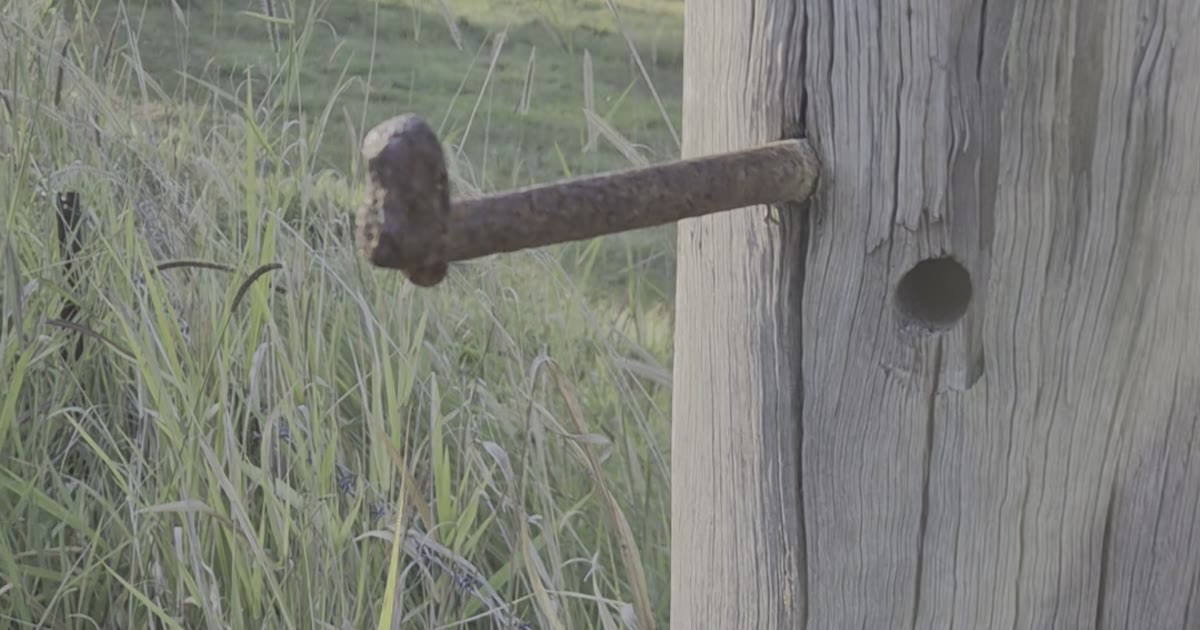
Before the grass, a small confession. When that fence went up there was a rusty bolt left sticking out of the corner post, and I remember standing there thinking I really should cut that off. It was ugly. It served no purpose. It’s the sort of thing a tidy person deals with on a Saturday.
I never got to it. Which means that for years now I have had a perfectly placed hook to hang a tool on while I work that corner. You can see it on the video, the hoe just drops straight onto it. Past me looked lazy. Present me is quietly grateful. If there is a lesson in gardening that keeps coming back around, it is that half the things we are ashamed of not finishing turn out to be fine.
Now the bit that actually matters
The dry lawns were not anyone’s fault. Our weather station here at Dayboro has logged 24.8mm of rain since the first of August. The last fall worth mentioning was 8.8mm on 24 August, ten days before that video. Everyone in the valley is dealing with the same nothing.
So where did my water come from? Not from the sky. At 6:50 that morning the station read 13.2 degrees with a dewpoint of 11.1 and humidity at 87 percent. Air that close to its dewpoint gives up moisture onto anything cool enough to take it. A mown lawn offers a short, sun exposed surface and very little of it. A shaggy paddock offers hundreds of times more leaf area, sitting in its own shade, with a layer of dead thatch underneath holding whatever lands. One collects the dew and keeps it. The other collects some and loses it by mid morning.
What the station recorded that morning
Rain since 1 August: 24.8mm. Last useful fall: 8.8mm, ten days earlier.
6:50am: 13.2°C, dewpoint 11.1°C, humidity 87%. A spread of two degrees is dew forming, not a forecast of it.
Where this goes wrong, because it does
I am not going to sit here and tell you that letting everything grow is always the answer, because it isn’t, and you’d rightly stop believing the rest of it. Long dry grass going into a hot spring is a fire load, and if you are on acreage near a boundary that matters more than your soil moisture does. It brings ticks. It hides snakes, which in this part of the world isn’t a theoretical problem. Some councils will have an opinion. And a paddock left alone for years does not stay diverse pasture, it goes to whatever bully species wins, which around here is usually something you didn’t want.
What I actually do is leave it long through the dry, then take it down before the fire season gets serious, and never scalp it. Cutting high is most of the benefit. You don’t have to choose between a bowling green and a jungle.
The part I really wanted to say
Gardening content has a way of making everybody feel behind. Straight beds, labelled rows, not a weed in the frame. Then you look out your own back door at the tomato you never staked, the bed you meant to turn over in July, the compost bin that has become a mystery, and it lands as evidence that you are doing this badly.
You’re not. Well, some of that mess is really just mess, sure. But a real garden in September looks like an unfinished argument, and that is true of everyone’s, including the ones that end up in photos. The bloke with the immaculate lawn was standing on dry dirt. My embarrassing corner was holding water. Neither of us planned it that way.
So if you are sitting on a bit of guilt about the state of your patch right now, put it down. Nature has been running this operation a lot longer than we have, and quite often the kindest thing you can do is stop helping so much and go and have a look at what is already working.
You are not the only one out here
Grow Together is where growers near each other swap the surplus and compare notes on what is actually happening in their beds, weeds and failures included. Joining a group is free, always. Only the person who starts one needs a paid plan. If your garden is a bit of a shambles this spring, you will fit right in.
GardenBuddy.au, subtropical vegetable growing at Dayboro, QLD. Weather figures from our own station, logged that morning.
Published 5 September 2026. Last updated 5 September 2026.