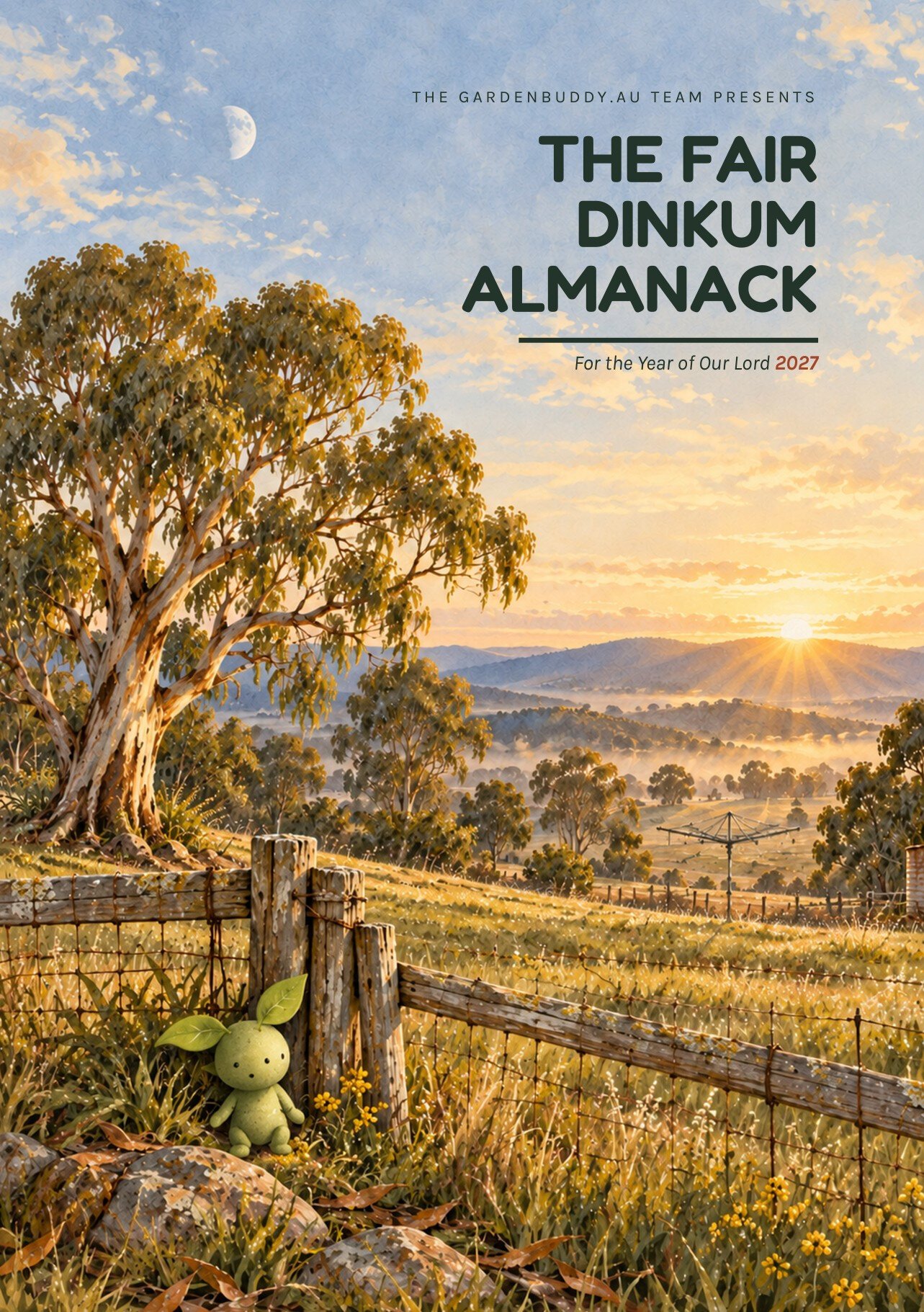
The farmer’s almanac is one of the oldest books a country can own. America has kept one going since 1792. Britain had them on every kitchen nail. Out here the farms read hand-me-down northern copies with the seasons upside down and the Moon lit from the wrong side, which is a strange way to run a country of farmers. So we built one for Australia. The Fair Dinkum Almanack 2027 is a real farmer’s almanac in the old manner, 72 pages, full colour, A5, and the cover says what the whole book believes: calculated, not guessed, in Queensland.
Get the Almanack here, $19.95 plus postage. Printed on demand and posted to your door.
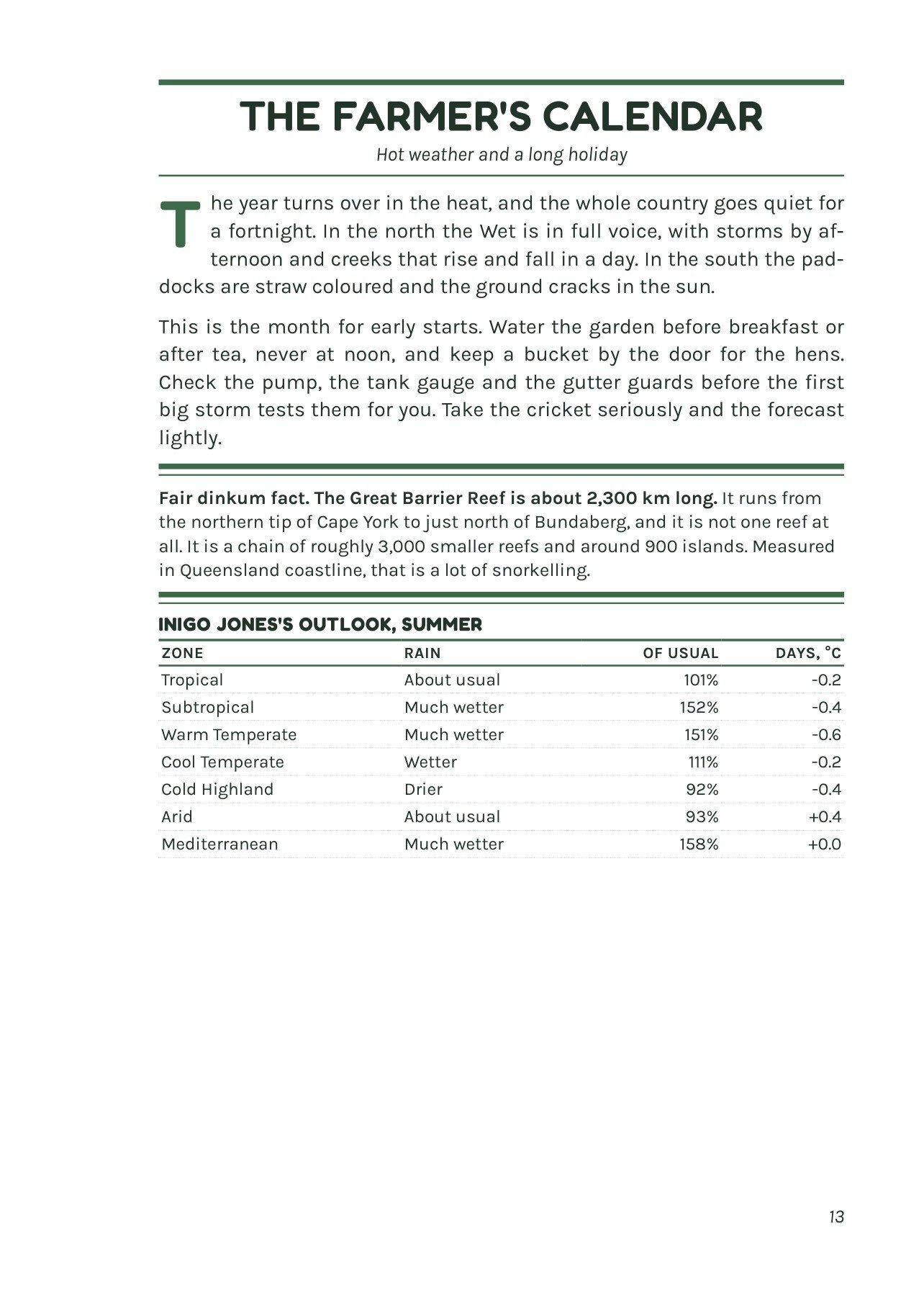
The Farmer’s Calendar, month by month
The heart of any farmer’s almanac is the Farmer’s Calendar, a short piece for each month on the work and the weather of the season, and ours keeps the shape exactly. January opens with the whole country going quiet for a fortnight while the Wet is in full voice up north and the paddocks crack in the sun down south. The advice is the kind your grandmother would have signed off on: water the garden before breakfast or after tea, never at noon, keep a bucket by the door for the hens, and check the pump and the tank gauge before the first big storm tests them for you.
July is the coldest month across most of the south, with hard frosts and clear nights, and the book tells you to plant bare rooted trees and roses while they are asleep, feed the winter vegetables something gentle, and keep the frost cloth handy. Then it sends you outside anyway: on a clear night the Southern Cross stands high in the evening and the Milky Way runs right across the sky. December ends the year the right way, water early, pick what is ripe and eat it, check the fire plan and the first aid kit, then sit in the shade with something cold and look at what the year has done.
That is twelve months of it. It reads like a yarn with someone who has done the work, because that is what the old Farmer’s Calendars were.
The Inigo Jones outlook: Australia’s own long range tradition
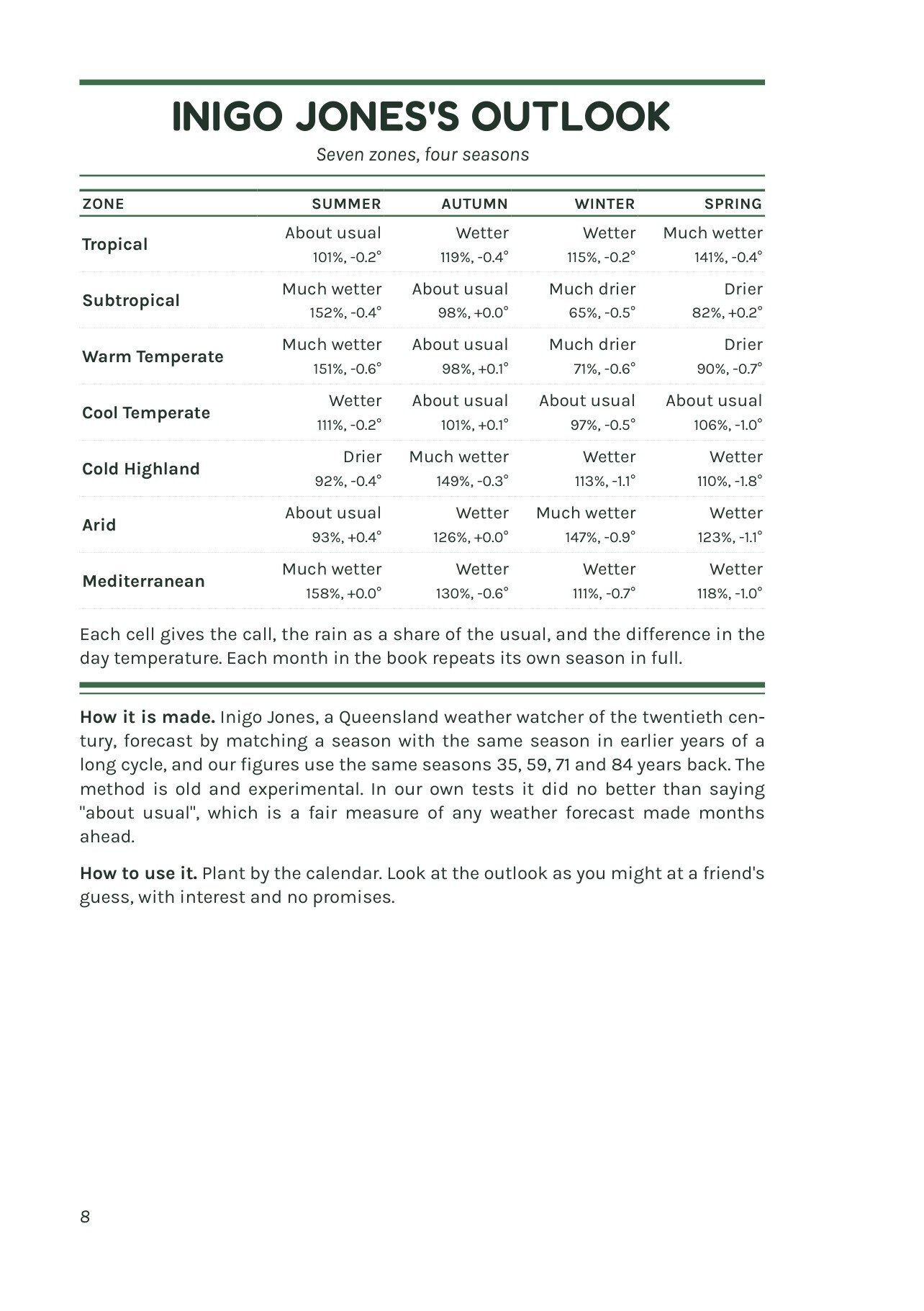
A farmer’s almanac needs a long range outlook, and Australia happens to own one of the most famous long range methods in the world. Inigo Jones was the Queensland weather watcher who ran the Crohamhurst Observatory from the 1930s and forecast each season by matching it with the same season in earlier years of a long cycle. The Almanack carries a full outlook built on his method, seven zones from Tropical to Cold Highland, four seasons each, using the seasons 35, 59, 71 and 84 years back, and each month repeats its own season’s call on the Farmer’s Calendar page.
And then we do something the old almanac men never did: we tell you how the method went in our own tests. It did no better than saying “about usual”. That sentence is printed in the book. Look at the outlook as you might at a friend’s guess, with interest and no promises, and plant by the calendar. We reckon a farmer’s almanac that is honest about its forecasting is worth two that are not.
Weather by lot, and weather by folklore
The old farmers’ almanacs gave every day of the year a weather word, months in advance, and never explained where the words came from. Ours gives every day a word too, Storms, Crisp, Scorcher, Sleet on the tops, but we say plainly how it is done: the words are drawn by lot, like a die thrown, weighted so a wetter month by the Inigo Jones call gets more wet words. It is a game, not a forecast, and the page says so. In the begin of the year you can pin your hopes on a Fine; by March you will have learned to read it with a grin, which is the correct way to read any forecast made months ahead.
For the weather wisdom itself there is a whole page of sayings of the country, none of them a forecast. “If the cows lie down, rain is coming, or they are tired.” “If your uncle says ‘she’ll hold off’, bring an umbrella.” “If the bureau says 10 per cent, assume you are the 10 per cent.” Underneath are ruled lines for sayings of your own, because every district has one that works better than it should.
Verses, paintings and the rest of the furniture
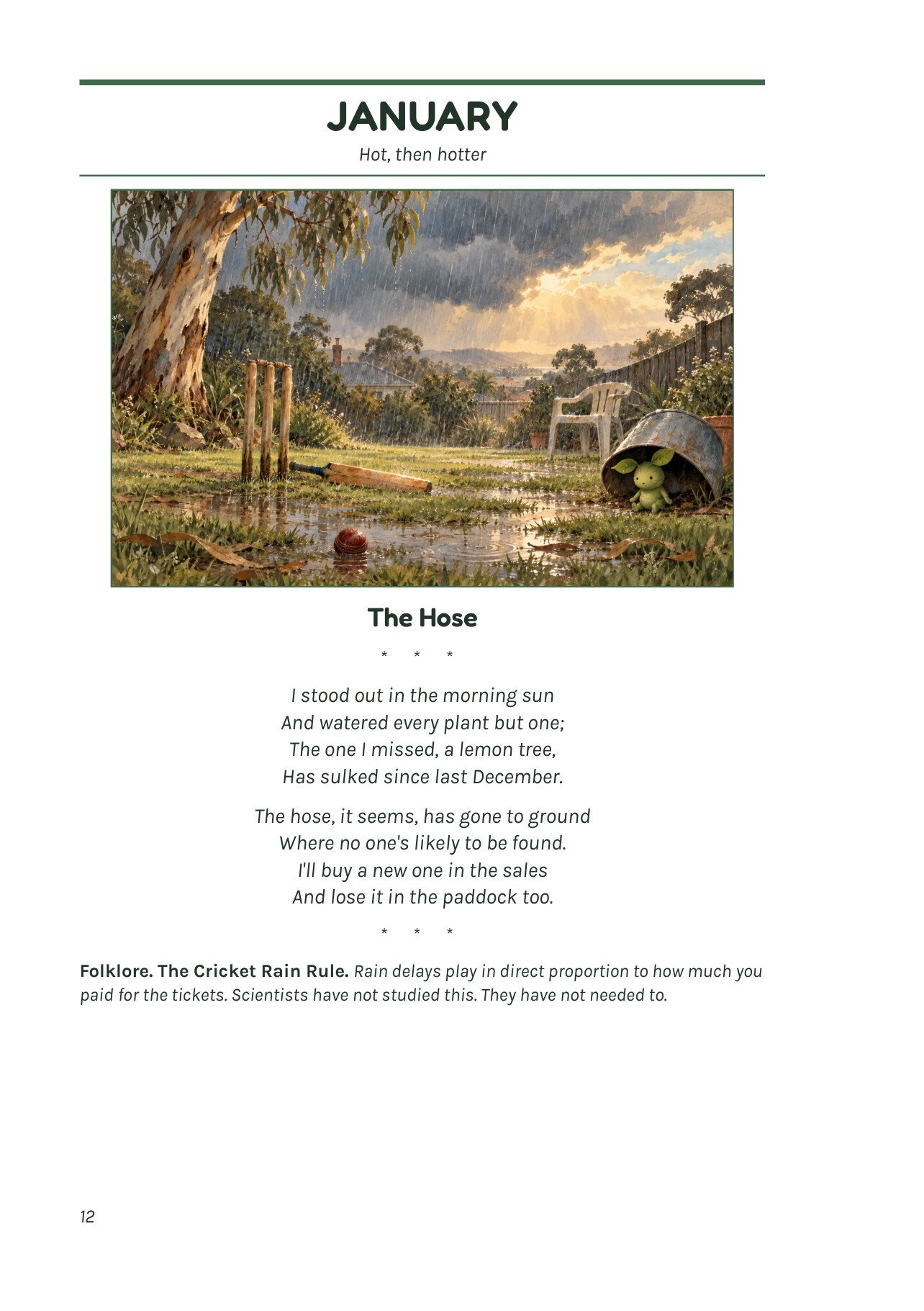
Every month has an original verse with its own painted scene. January’s is The Hose, abotu the one plant you always miss (“The one I missed, a lemon tree, Has sulked since last December”). July’s is The Long Road, with a wedge-tail circling and pie promised at the end. On the picture above each verse sits a little leaf fellow you will come to look for, month by month, the way you look for the cattle dog in the back of every passing ute.
The household hints page is subtitled “old receipts, for what they are worth” and delivers exactly that: a wooden spoon laid across the pot stops it boiling over, a fresh egg lies on its side in a bowl of water, pine cones close when the air is damp, and the Southern Cross will find you south any clear night. Folk advice, offered in good faith and without any guarantee, which is more honesty than most of the internet manages.
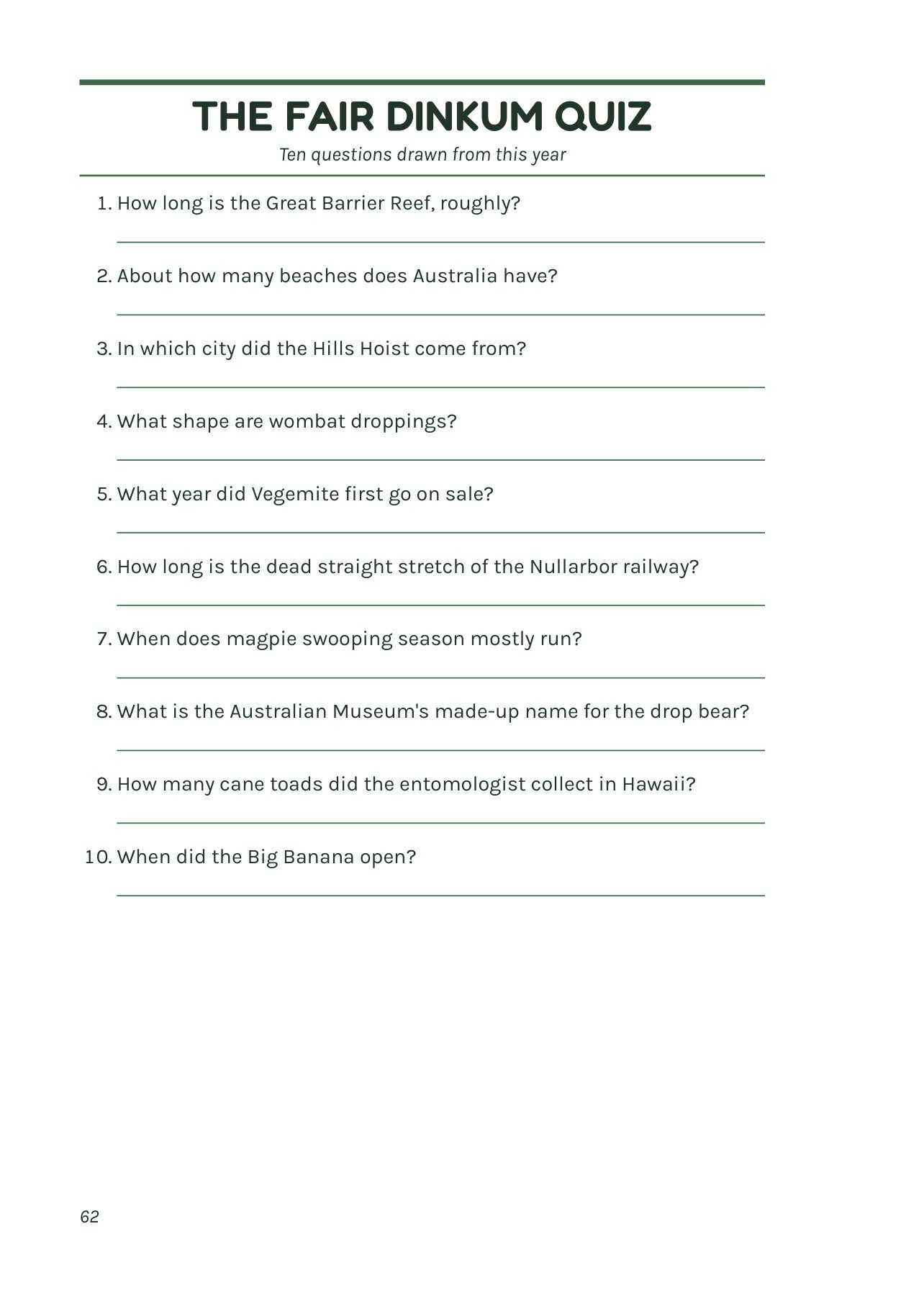
Each month also carries one fair dinkum fact with its source listed at the back. December’s is a beauty: the Big Banana at Coffs Harbour opened on 22 December 1964, the idea of John Landi, who bought a banana plantation in 1962 and built a 12 metre banana to pull the tourists in. The book even notes the dispute, the Big Scotsman in Adelaide is said to be older and Ploddy the dinosaur was built in 1963, because a farmer’s almanac should be reliable even about fibreglass fruit. The Nullarbor railway runs dead straight for 478 km. Wombats make cube shaped droppings, and there is a 2018 Georgia Tech and University of Tasmania study behind that line.
The quiz that settles the arguments
Ten questions drawn from the year’s facts, answers over the page, no peeking beforehand. How long is the dead straight stretch of the Nullarbor railway? What is the Australian Museum’s made-up scientific name for the drop bear? (It is Thylarctos plummetus, and yes, the Museum really has a fact sheet.) The scoring line tells you where you stand: 9 to 10, you settle the arguments. 5 to 8, a sound pub team. 0 to 4, a good time was had by all.
Well, we have watched this page get read out loud at a table, and it does not stay quiet long. Two pages of Australian, translated, sit next to it, arvo to no worries, for the visitor or the grandchild who needs them.
Where the garden fits
If you came here for the growing side, we keep a living Farmers Almanac on GardenBuddy.au that updates with real prices and planting windows for your zone, and the seven Garden Year 2027 planners carry the bed-by-bed work. The printed Almanack is deliberately not a gardening book, it says so on the back cover. It is the book for the kitchen table and the caravan shelf, the one you pick up in the evening when the work is done. The two belong together the way the shed and the verandah do.
We wrote a full tour of the whole book, the Sun and Moon tables for every day of 2027, the eclipse notes, the capitals page, in our launch post, if you want the lot.
Quick answers
Is this like the American Old Farmer’s Almanac? Same family, built for the right hemisphere. Farmer’s Calendar every month, long range outlook, folklore, verse, facts and a quiz, but the seasons run the Australian way, the Moon is lit on the correct side, and the facts are ours.
Does it actually predict the weather? No, and it is the rare almanac that admits it. The daily weather words are drawn by lot and the Inigo Jones outlooks tested no better than “about usual”. The one promise printed in the book: the Sun will rise tomorrow, and we have the time.
Will it work for my state? Yes. The tables are fitted to Canberra and answer for all the states, with a capitals page and a worked rule of thumb for your own town. Brisbane reads about 16 minutes earlier, Perth about 17 minutes later, and the book shows the sum.
How much, and how long to arrive? $19.95 plus postage for a 72 page A5 paperback in full colour, printed on demand. Allow about two weeks to your door, so for Christmas, order early.
The old almanacs hung on a nail and got opened every day for a year. This one is built to earn the same nail. Order The Fair Dinkum Almanack 2027 here.
The GardenBuddy.au team