

User guide · features and tools · 6 min read
Advice written for your zone, not for somewhere else.
Australia has seven distinct climate zones for growing vegetables. /veggie-guide/ has a landing page for each, plus 156+ crop-specific sub-pages per zone, 1,918 free, Google-indexed Australian planting references.
 Every guide is Australian. None of it is northern hemisphere advice with the dates flipped.
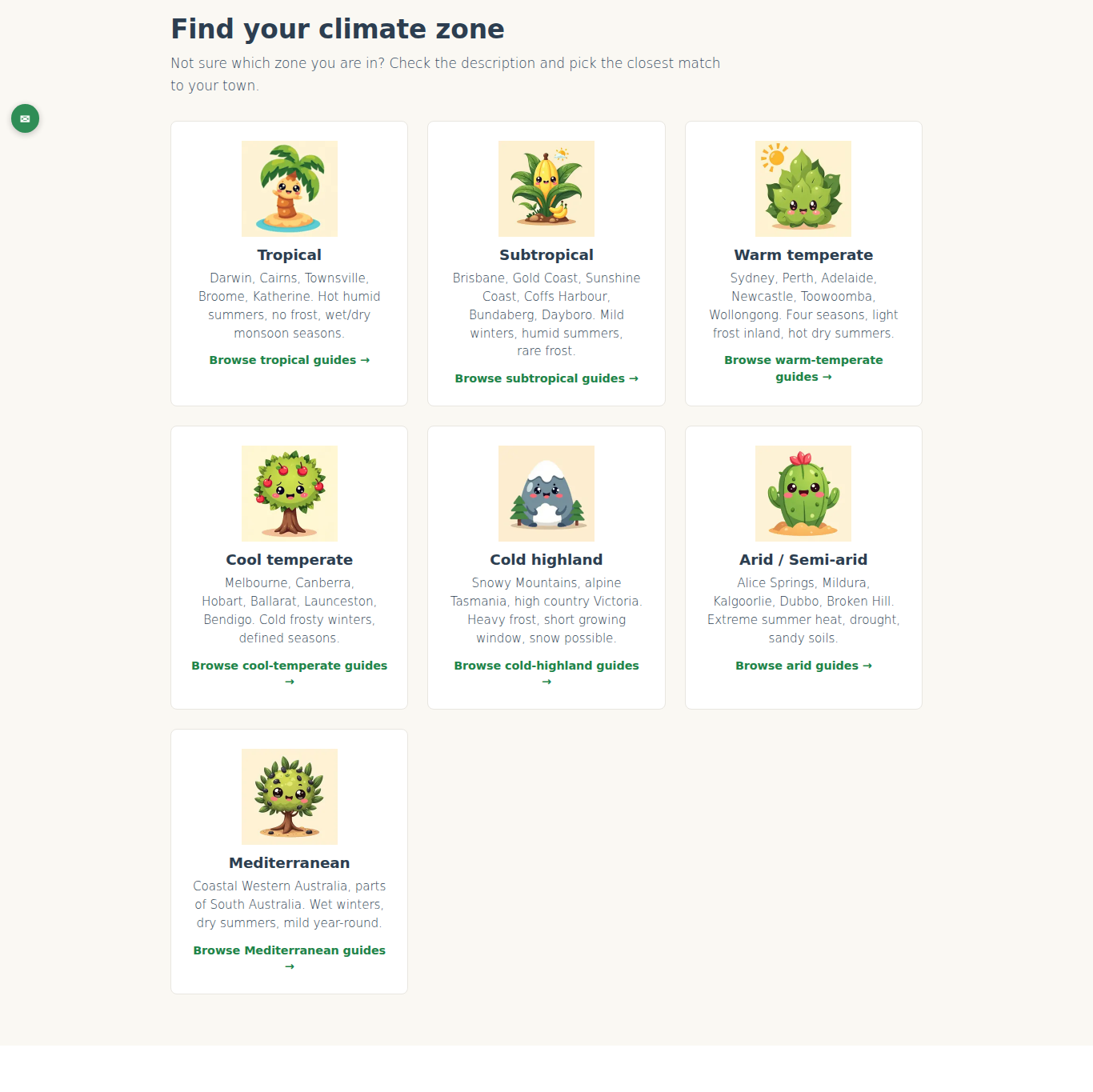
The seven zones
| Zone | Includes | Character |
|---|---|---|
| Tropical | Darwin, Cairns, Townsville, Broome, Katherine | Hot humid summers, dry winters, no frost, monsoon seasons |
| Subtropical | Brisbane, Gold Coast, Sunshine Coast, Coffs Harbour, Bundaberg, Noosa | Mild winters, humid summers, rare frost |
| Warm temperate | Sydney, Newcastle, Toowoomba, Wollongong | Four distinct seasons, light frost inland, hot dry summers |
| Cool temperate | Melbourne, Canberra, Hobart, Ballarat, Launceston, Bendigo | Cold frosty winters, mild summers |
| Cold highland | Snowy Mountains, Kosciuszko, Guyra, Oberon | Heavy winter frost/snow, short growing season |
| Arid / semi-arid | Alice Springs, Broken Hill, Mildura, Mount Isa | Hot dry, large day/night temperature swings, irrigation-dependent |
| Mediterranean | Perth, Adelaide, coastal WA and the settled parts of SA | Dry summer, wet winter, mild overall |
Each zone page
Every zone landing page has:
- Intro to the zone’s growing calendar, frost-free? summer storms? dry winters?
- What’s in peak planting season right now, pulled from the same data as /plant-now/
- Links to all 156+ crops with month-by-month planting charts specific to that zone
- Variety recommendations that perform in that zone
Per-crop per-zone pages
URL pattern: /veggie-guide/{zone}/{crop}/. Example: /veggie-guide/subtropical/kale/.
What each page shows
- 12-month planting calendar, which months to plant in this zone
- Current month highlighted
- Soil temperature range for germination
- Typical days to harvest in this zone
- Companion plants and incompatibilities
- Pest warnings specific to this zone
- Variety recommendations that perform in this zone
- Harvest expectations (what to expect, when to pick)
- Common problems local to this zone
every crop × 7 climate zones = hundreds of individual pages. Every one is indexed and discoverable. If you search “when to plant broccoli Toowoomba”, our warm-temperate broccoli page should be the first or second result.
The SEO strategy is deliberate: we believe public planting advice should be free, and the paywall should be on the personalisation (tracking your own garden, weekly digest) not on the zone data.
Your zone on the care guides
The care guides are the other half of this. A zone page tells you when to plant. The care guide at /vegetables/{crop}/ tells you how to grow it, and since August 2026 it reads differently depending on where you garden.
Near the top of every care guide there is now a line saying which zone the page is written for. Under it, a section called In Your Climate Zone holds four things for each of the seven zones:
- When to plant, the sowing window that actually works in that climate
- What to watch, the problems that zone brings, such as fruit fly all year in the tropics or frost at both ends of the season up high
- Tips, what experienced growers in that zone do differently
- Varieties that suit it
Your own zone opens first and is tagged. The other six are still there, collapsed, and you can open any of them. That is deliberate. If you garden near the edge of a zone the advice next door is often the advice you need, and hiding it would help nobody.
From your postcode, if you have set one in My Garden. If you have not, the page shows all seven zones and invites you to set it. You can also force a zone for one page by adding ?zone=cool-temperate to the address, which is handy if you are growing for someone in another state.
The variety lists work the same way. A variety recorded as suiting particular zones sorts to the top when it matches yours, and is labelled when it does not, but it is never hidden. Knowing that a heat tolerant cultivar exists is useful even in Hobart.
103 of our 107 crops carry notes for all seven zones. The four without them are bok choy, summer savory, winter savory and spring onions, where we do not yet have zone-specific advice we would stand behind. Those pages still carry the full care guide, just not the per-zone section.
Not sure which zone you’re in?
Town reference table (abbreviated)
| Town / Region | Zone |
|---|---|
| Brisbane, Ipswich, Logan, Sunshine Coast, Gold Coast, Caboolture, Samford | Subtropical |
| Toowoomba (high), Warwick, Scenic Rim | Warm temperate (cooler sub-zone) |
| Sydney + Central Coast, Newcastle, Wollongong | Warm temperate |
| Melbourne, Geelong, Ballarat | Cool temperate |
| Hobart, Launceston | Cool temperate |
| Canberra | Cool temperate (cold sub-zone) |
| Adelaide, Fleurieu Peninsula | Mediterranean |
| Perth, Margaret River | Mediterranean |
| Darwin, Cairns, Townsville | Tropical |
| Alice Springs, Mildura | Arid / semi-arid |
Still unsure?
Find the nearest big town to you. If you’re genuinely between zones (Toowoomba is warm-temperate but the Scenic Rim is subtropical; Adelaide Hills sits between warm-temperate and Mediterranean), pick the zone closest to your altitude and rainfall pattern.
Microclimate within your own yard can shift things further, but until you’ve observed 2–3 seasons, plant to the regional zone average and note what worked.
Where the zone data comes from
Aggregated and manually curated from:
- Bureau of Meteorology climate zone definitions
- State agriculture department planting guides (DAF Queensland, DPI NSW, Agric Victoria, Agric WA)
- Heirloom seed-supplier planting charts (Diggers, Green Harvest, Eden Seeds)
- Heritage published resources, The Little Veggie Patch Co, Linda Woodrow, Peter Cundall archive
- Member reports of what actually works in their specific micro-region
If you spot an error or have a local correction, email us with evidence, we fix these within a week.