Most of our How To posts pull one GardenBuddy.au tool apart on its own. This one is different. The GardenBuddy.au team wanted a single flagship walkthrough that follows one real crop through a whole season, using every stage the site actually supports, choosing it, timing it, protecting it, feeding it and checking on it when something looks wrong. We picked capsicum. Here is the whole season, one tool at a time.
Just over two minutes, one capsicum, seven GardenBuddy.au tools, one season.
Why capsicum, and why only one crop gets this
Capsicum earns the spot because every stage of this walkthrough has real, checkable data behind it on GardenBuddy.au: a live tracked price, a planting window in all seven grow zones, a documented frost sensitivity, a well sourced pest profile and a place in the companion planting guide. Tomato and carrot are already the worked examples on two of our other guides (see Related features below), so we picked the crop that had not already had its turn.
This is a one-off. We are not going to publish this same seven-step structure for every vegetable in the catalogue. Capsicum gets the full treatment so the shape of it exists once, properly, and every other guide on the site can point back to it.
The season, stage by stage
1. Deciding it is worth growing
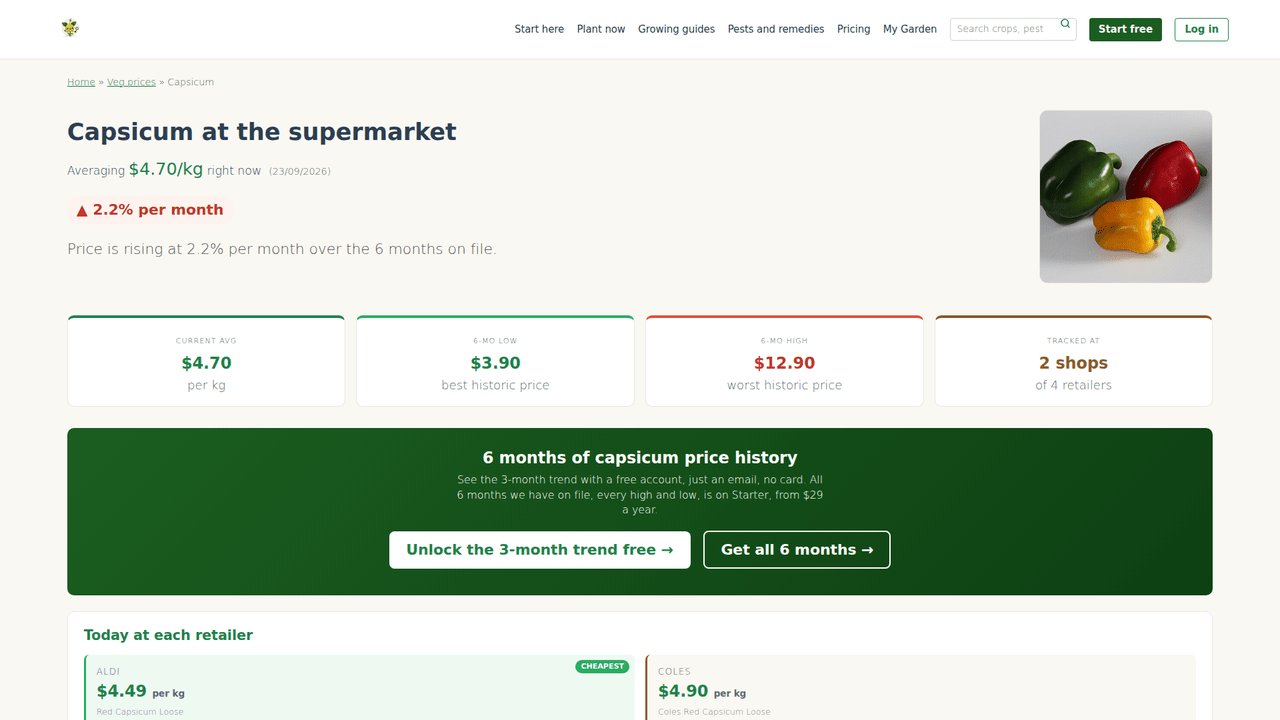
Open gardenbuddy.au/prices/capsicum/ and the tracker has capsicum averaging $4.70 a kilo right now, rising at 2.2% a month over the six months on file. ALDI is the cheapest of the two retailers currently tracked, at $4.49. That rising trend is exactly the kind of signal the grow vs buy walkthrough is built around, a price moving in one direction gives a spare bed a job to do.
2. Finding the planting window for your zone
The Grow Zone Map splits Australia into seven zones: Tropical, Subtropical, Warm Temperate, Cool Temperate, Cold/Highland, Arid/Semi-Arid and Mediterranean. Capsicum’s planting calendar is different in every one of them. In Subtropical zones, where the GardenBuddy.au team is based, capsicum goes in from August through most of spring and again from January. Cool Temperate and Warm Temperate zones are limited to a narrower spring to early summer window, and Cold/Highland gardeners get the shortest run of all, spring only. Check your own postcode on the map before you commit seed or seedling.
3. Timing the actual planting day
Capsicum is a fruiting crop, so the Moon Calendar‘s fire and earth days are the ones worth lining up with. The calendar’s own logic runs First Quarter through Waxing Gibbous as the fruiting window, tomatoes, beans, peas and capsicum among them, as the moon waxes from new to full. Pick a planting weekend that falls in that stretch and you are working with the same simple rule the rest of the calendar runs on, not against it.
4. Choosing its bed mates
The Companion Planting Guide covers 70 crops, and capsicum’s row lists eggplant, nasturtiums, basil, parsley and amaranth as the plants it grows well next to. Basil and parsley are doing double duty here, both are companions for capsicum in their own right and neither competes hard for the same root depth or light. None of it replaces good soil, but it costs nothing to plan the bed that way from the start.
5. Watching the overnight low
Once the seedling is in, the Frost Risk tool becomes the thing to check. Type in a postcode and it returns the next seven forecast overnight minimums, each one flagged for frost risk. Capsicum sits on the tool’s own named list of tender crops to protect, alongside tomato, basil, cucumber, zucchini and pumpkin. A forecast minimum of 2°C in the open can still mean ice on the lowest leaves, so a sheet of shade cloth or an upturned pot over a young plant the night before a flagged frost is the practical response, removed again in the morning.
6. Watching for what is actually going to eat it
The Pests and remedies library lists Queensland fruit fly as capsicum’s main threat, cross checked against Queensland DAF, NSW DPI and Agriculture Victoria sources. The fly pierces ripening fruit and lays eggs beneath the skin, and it is active across warm months in tropical, subtropical, warm temperate and Mediterranean zones. Exclusion netting or fruit bags before fruit ripens, protein based lure traps hung from early spring, and picking fruit slightly under ripe are the organic, home garden level responses the guide sets out. There is no reliable companion plant that repels fruit fly on its own, netting and traps do the actual work.
7. Checking on a plant that still looks wrong
If a leaf yellows or something starts chewing through a capsicum plant despite all of the above, the Free Plant Check takes a photo and returns a diagnosis tuned to your own climate zone in seconds. It is one free check a month with a free GardenBuddy.au account, no card required, and where the plant is one of the crops GardenBuddy.au already writes guides for, the result links straight back to that guide.
Frequently asked questions
Do I need a paid account to follow this whole walkthrough? No. Every tool used here, the price tracker, the grow zone map, the moon calendar, the companion planting guide, the frost risk tool, the pest library and one plant check a month, is available on a free GardenBuddy.au account. Paid tiers unlock extra history and extra checks, not the tools themselves.
Does the frost risk figure change by grow zone? The frost forecast itself is calculated for whatever postcode you enter, so it already accounts for your local climate. The tender crop list, capsicum included, is the same nationally, because capsicum is frost sensitive everywhere it is grown.
Why capsicum and not another crop with a rising price? Several vegetables were rising when we checked, but capsicum was the one with a clean, complete data trail across every stage of this walkthrough, price, zone, moon timing, companions, frost and a well documented pest. That completeness is what a one-off flagship guide needs.
Related features
- Using the Price Tracker to Decide What to Grow vs Buy: the same grow or buy decision, worked through with tomato as the example.
- The Australian Grow Zone Map: the full explainer behind step two above.
- The Moon Calendar: the full explainer behind step three, including all eight moon phases.
- Companion Planting Guide: the full 70 crop guide behind step four.
- The Frost Risk Tool: the full explainer behind step five.
- The Free Plant Check: the full explainer behind step seven, including what it is not good at.
Try it now
Start at the real number for this crop: check today’s capsicum price, then find your own planting window on the Grow Zone Map. Everything from there follows the same seven steps, whatever you end up growing.