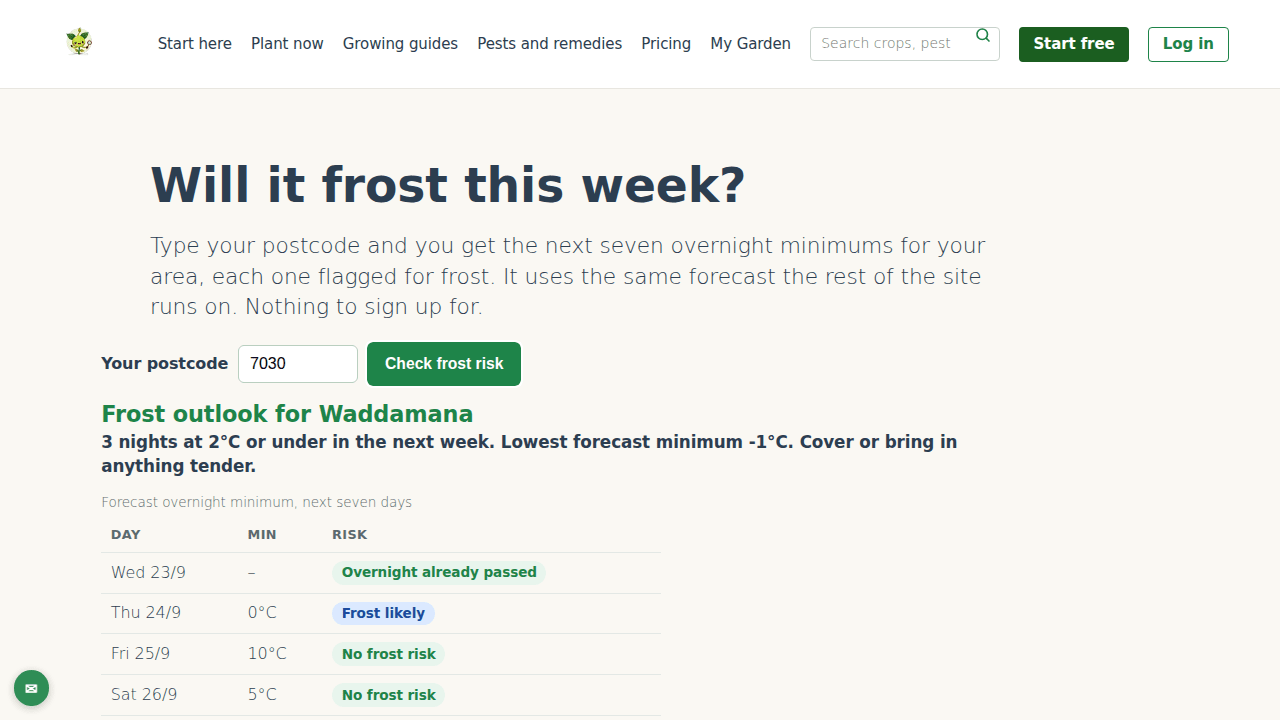
Type your postcode into gardenbuddy.au/frost-risk/ and you get the next seven overnight minimums for your area, each one flagged for frost. No sign up, no app, just a postcode. Here is what it does, how the risk levels work, and how to actually use the answer.
Under two minutes on what the Frost Risk tool shows and how to read it.
What the Frost Risk tool actually shows
Enter your postcode and the tool returns a table of the next seven days, each with a forecast overnight minimum and a risk tag. There are four tags, tied directly to the forecast number, not a vague “cold” or “mild”:
- Frost likely – the forecast minimum is 0°C or under.
- Frost risk – the forecast minimum is 2°C or under.
- Cold, cover seedlings – the forecast minimum is 4°C or under.
- No frost risk – anything above that.
Above the table sits a one line verdict for the whole week: how many nights hit frost risk or under, and the single lowest minimum forecast in the next seven days. Below it, a note most people miss on their own: a forecast minimum is measured in the open at screen height. On a still, clear night the ground and any low leaves sit two to four degrees colder than that reading, so a “mild” 4°C forecast can still mean ice on the lowest leaves by morning.
Where the numbers come from
The tool is not a separate frost model. It reads from the same postcode weather feed the rest of GardenBuddy.au runs on, the Bureau of Meteorology’s forecast, blended with a local weather station where the site has one. For most of the country that means a BOM precis forecast. Around Dayboro, Queensland, where the GardenBuddy.au team is based, it blends in live readings from the team’s own WeeWX weather station instead of relying on BOM alone.
That local blending is also why Dayboro’s own postcode almost never shows a frost tag. Checked against the live tool this week, Dayboro’s seven day outlook read “No frost risk in the next seven days,” lowest forecast minimum 11°C. Dayboro gets a heavy dew on a still night, not a frost, and the tool’s own numbers back that up rather than assuming the town behaves like the rest of the country. Colder inland and alpine postcodes are a different story: the same check against a Tasmanian highland postcode this week returned two nights at “Frost likely,” forecast minimums of 0°C and -1°C.
Why it matters
A frost warning that only says “cold tonight” leaves you guessing whether it is worth dragging pots inside. A number and a threshold do not. Tender crops, tomato, capsicum, basil, beans, cucumber, zucchini and pumpkin, can go from thriving to blackened leaves in one bad night. Knowing three days out that Thursday is the frost night, not Wednesday, is the difference between covering the right night and covering every night out of caution.
How to use it
- Check before a cold snap: type your postcode, read the verdict line, and look for the first “Frost likely” or “Frost risk” tag in the table.
- Cover the tender crops, skip the hardy ones: tomato, capsicum, basil, beans, cucumber, zucchini and pumpkin are worth a sheet, shade cloth or an upturned pot before dark. Brassicas, peas, broad beans, garlic and onions shrug a frost off, no cover needed.
- Take covers off in the morning: a cover left on all day traps heat and moisture the plant does not need.
- Treat “Cold, cover seedlings” as the safer read: screen-height forecasts run two to four degrees warmer than ground level on a still, clear night, so a 4°C forecast is closer to the real risk than it looks.
- Your postcode is remembered: the tool saves it in your browser, so the next visit shows your outlook straight away without retyping it.
Frequently asked questions
Does this replace a last frost date? No. This is a seven day forecast, not a frost date climatology. GardenBuddy.au does not yet hold a per-postcode last-frost-date table. For planting windows that already keep tender crops clear of the usual frost months in your zone, use the planting guides, written per climate zone.
Do I need to know my grow zone first? No, the postcode is enough for the frost check itself. If you also want to know what to plant and when, find your zone on the grow zone map first.
Does Dayboro actually get frost? Rarely. Checked against the live tool, Dayboro’s forecast minimums this week sat well clear of any frost tag. The area is more prone to a heavy overnight dew than an actual frost, and this tool’s own numbers reflect that rather than assuming otherwise.
Do I need an account? No. The frost check is open to everyone, no sign up.
Related features
- Grow Zone Map: find your climate zone so the seasonal advice you read elsewhere on the site matches your actual conditions.
- Veggie growing guides: zone-based planting windows that already keep tender crops clear of the usual frost months.
- Farmers Almanac: the longer range, month-by-month view for planning a season ahead rather than the coming week.
Try it now
Head to gardenbuddy.au/frost-risk/, type your postcode, and see whether this week is a covering week or not. It costs nothing and takes a postcode, that is all.