

User guide · features and tools · 8 min read
The vegetable garden planner app, your garden drawn to scale.
A free garden planner app for Australian veggie growers, no download and no account needed. Draw your beds at real size, drop crops in, and the planner tells you how many plants actually fit at proper spacing, what the harvest is worth at supermarket prices, and prints you a planting map with a shopping list. You can try all of it before you even have an account.
 No app store, no download. It runs in your browser and can sit on your home screen like an app.
What the planner is, and where it lives
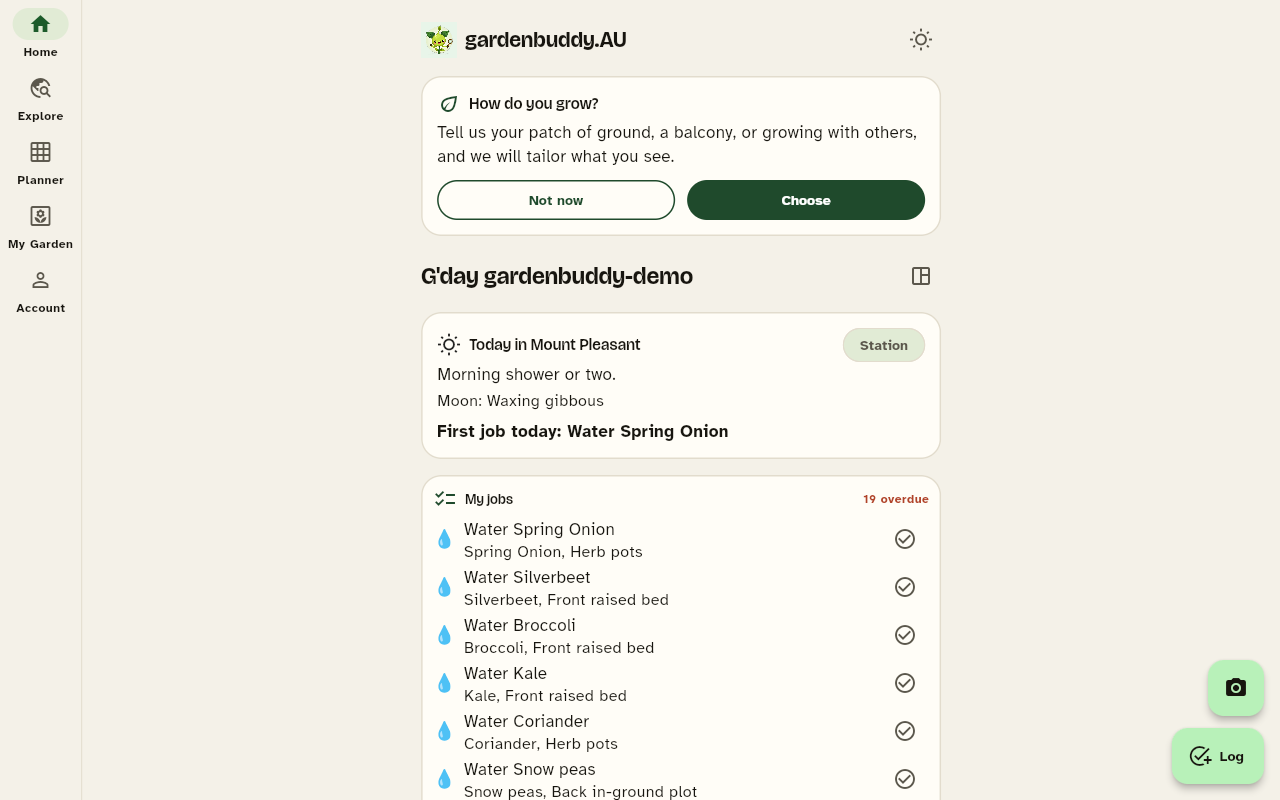
The planner is a separate app that runs in your browser at gardenbuddy.au/app/. There is nothing to install and nothing in an app store, and the crop spacings and climate zones are Australian, not borrowed from a northern hemisphere planner. It has five tabs along the bottom (or the side on a wide screen): Home, Explore, Planner, My Garden and Account. This article is about the Planner tab, the part that draws your garden to scale.
The quickest ways in:
- Type gardenbuddy.au/app/ into any browser.
- Tap Open the planner app on your member home.
You can open the planner and draw a whole garden without signing in. It runs as a demo plan with a banner telling you so. Everything works, fit counts, value, the lot. The demo plan lives only in that browser tab, so the moment you want to keep it, you sign in and save. More under Saving plans.
Drawing beds to scale
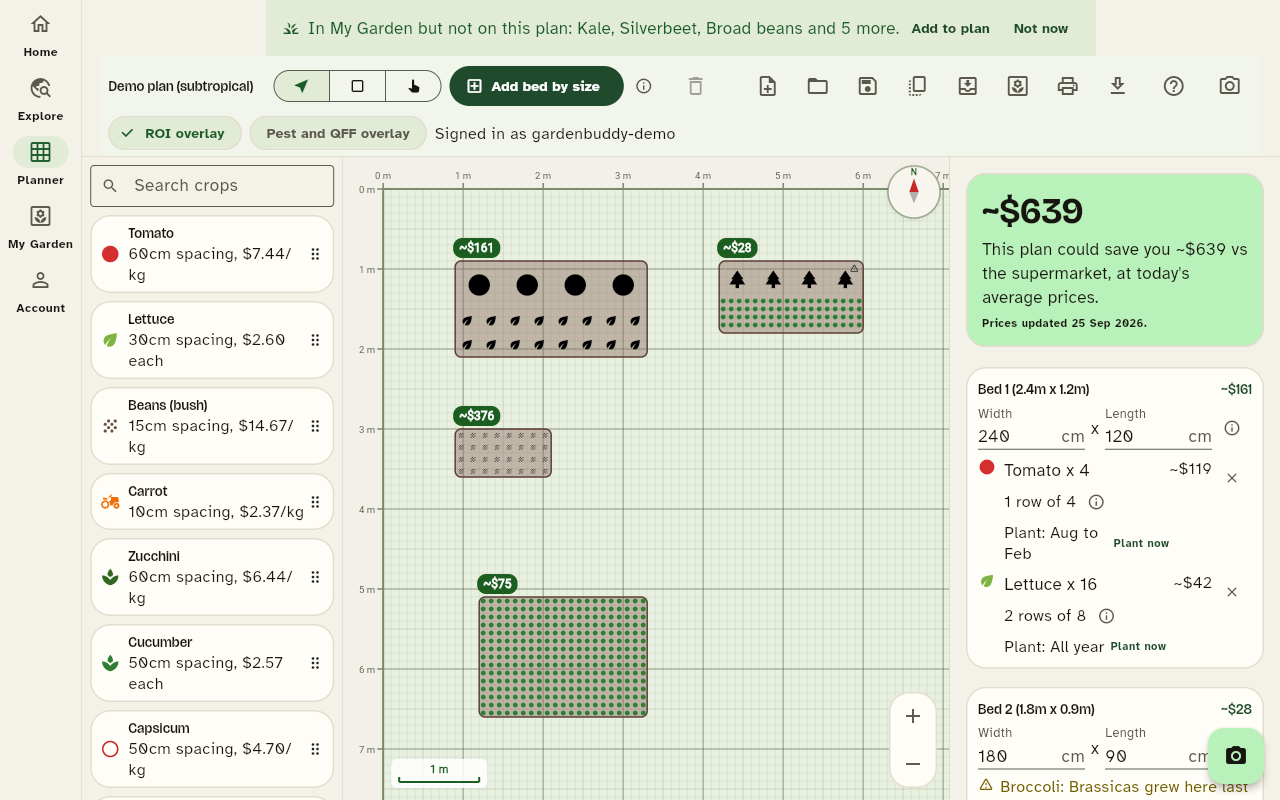
The planner works on a 10 cm grid. One square is 10 cm by 10 cm, and the canvas runs to 12 m by 9 m, which covers most backyards. A 1 m scale bar and rulers along the edges keep the sizes honest, and a short coaching strip walks you through your first visit.
Two ways to make a bed:
- Draw it. Drag out a rectangle on the grid. Sides snap to the nearest 10 cm.
- Add bed by size. Type the measurements in metres or centimetres, or pick a preset: 240 × 120 (the classic sleeper bed), 200 × 100, 180 × 90, 120 × 120 wicking, or 120 × 60 balcony. The bed is placed for you with a 30 cm path around it.
Bed sides round to the nearest 10 cm and are kept between 30 cm and 12 m. Go measure your real bed with a tape first; the whole point of a to-scale planner is that the numbers are yours.
The compass
On the Planner tab there is an 8-point compass. Telling the planner which way your garden faces feeds the sun model, which matters most for balconies and shaded yards. It sets the aspect; it does not rotate your beds.
How the plant counts are worked out
Drop a crop into a bed and the planner answers the question every seed packet dodges: how many actually fit. It uses each crop’s real spacing, works out plants per row and number of rows, and says it plainly, for example “32 plants, 4 rows of 8”. Put more than one crop in a bed and the bed is split into strips, one per crop, each with its own count.
The spacing comes from a catalogue of 70 crops, each with spacing, days to maturity, typical yield per plant, and whether fruit fly is a risk. The spacings are curated from Australian sources (Gardenate’s AU data, Queensland DAF, Diggers), not measured in our own trials, and the app says so. The same catalogue drives the crop pages on the website, so the numbers agree everywhere.
The planner reads instructions from the address bar. A link like /app/?tab=planner&bed=240x120&crops=tomato,basil opens the planner with that bed drawn and those crops ready. Our emails and blog posts use these, and you can share one with anybody, it works before they sign in.
Saving plans, who keeps how many
Drawing needs no account. Saving does. When you hit Save without being signed in, a sign-in sheet opens right inside the app, username or email plus password, and you stay signed in on that device for a year. No bouncing out to a login page and losing your work.
| Plan | Saved plans |
|---|---|
| Free | 1 |
| Starter | 20 |
| Pro | 20 |
The free plan keeps one saved plan, which is enough to plan one season properly. Hit the limit and the app says exactly what your options are: delete the old plan, save over it, or move to Starter at $29 a year. Once a plan is saved, Plant this plan pushes its crops into your garden journal so the tasks and harvest dates start flowing; that works for the free plan’s single saved plan too.
Your saved plans are not held hostage. A lapsed member can still sign in, open every saved plan, print it and export it. What needs an active paid plan is saving new ones beyond the free allowance.
Value, print and export
Three outputs, and all three are available to everyone, signed in or not:
- Plan value. The planner totals what your planned harvest would cost at supermarket prices, the same price data behind the price tracker.
- Print. Each bed prints as a to-scale map with a dot for every plant at its real spacing, plus a shopping list of seedlings (assuming 6 to a punnet) and seed prices where we track them; where we do not, it says “not tracked” rather than guessing.
- CSV export. The full plan as a spreadsheet, yours to keep.
The printed map is the planner’s best trick. Pin it to the shed wall, and planting day is just putting seedlings where the dots are.
Offline, and putting it on your home screen
The app keeps a copy of your plan list, your most recent plan and your garden data on the device, so patchy reception in the backyard does not blank the screen. Offline you get a banner saying how old the saved data is, your most recent plan opens read-only, and if you try to save, the app tells you the truth: “You’re offline. Save again when you have reception.” Nothing is silently queued and lost.
To make it feel like an installed app, use the install card the app shows: on Android and desktop Chrome there is a one-tap Install button; on iPhone, open the Share menu and choose Add to Home Screen. Either way you get a GardenBuddy.au icon that opens straight into the app.
Common questions
Do I need to download anything from an app store?
No. The planner is a web app at /app/. The home-screen install above is the closest thing to “downloading” it, and it is optional.
Is my postcode used in the planner?
If you arrive through a link that carries a postcode, the app looks up your climate zone from it, and carries on fine if the lookup fails. Your zone mainly matters on the website side, the crop guides and your member home.
Why can’t I use the plant camera offline?
GardenBuddy.au Check (the Pro photo check) needs a connection to analyse the photo, so the camera is disabled while offline rather than pretending.
Does the free plan cripple the planner?
No. Drawing, fit counts, value, print and CSV are identical on every plan. Free keeps 1 saved plan and paid plans keep 20; the journal it plants into keeps free at 1 bed and 10 plants. That is the whole difference.