Some gardeners want an app. Others want a chart on the fridge they can glance at while the kettle boils. GreenThumb Magnets makes the second kind, and over the past few weeks we have worked alongside them. This is what that looked like.
What GreenThumb Magnets makes
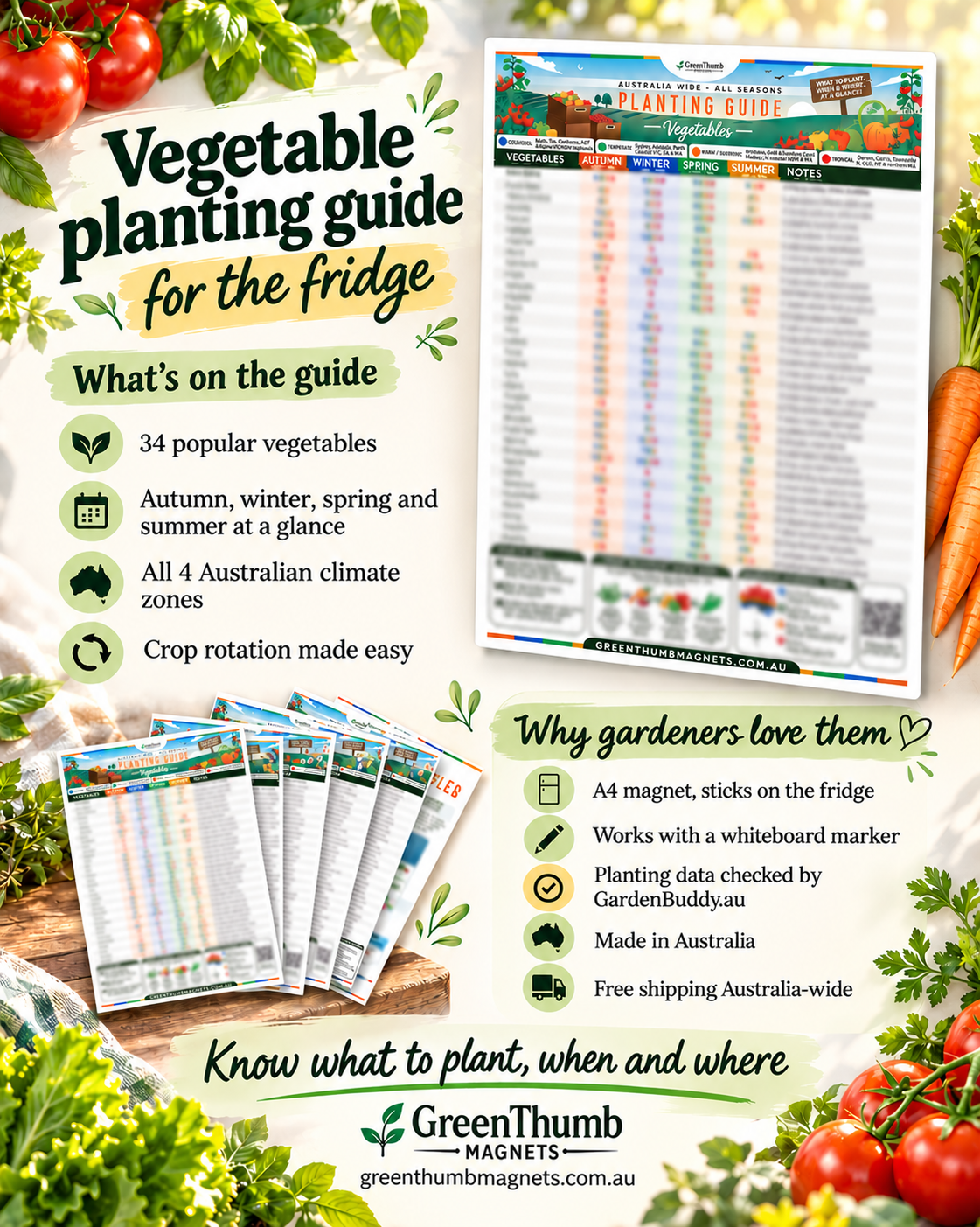
GreenThumb Magnets makes A4 magnetic planting guides that stick to the fridge, so you can see what to plant and when at a glance. The Complete Collection has all six guides: Vegetables, Culinary Herbs, Tea and Garden Herbs, Fruits and Berries, Flowers, and How to Store Fruits and Vegetables. They are made in Australia, designed in Tasmania and printed in Melbourne. Each set comes with a botanical gift envelope and free postage Australia-wide.
Take the Vegetable guide: 34 popular vegetables, autumn, winter, spring and summer at a glance, all four Australian climate zones, and crop rotation made easy. It is an A4 magnet that works with a whiteboard marker, so you can write on it.
What we did together
GreenThumb Magnets built the charts from their own planting data, and every dot on them is their call. We brought our planting data, which holds crops across seven Australian climate zones. Before the guides went to print, we put the two side by side and compared them, crop by crop and season by season. Where they differed, we passed on what we saw and why, and GreenThumb Magnets decided what went on the chart.
Two sets of data built by different people will never match everywhere, and a chart that covers the whole country has to simplify. Comparing them was still worth doing, because each side saw things the other had missed.
What we compared
We matched 66 plants between the guides and our data. One example is the tropics, where our data puts most vegetable planting in the dry season, roughly March to August. A four-zone chart has to decide how to show that, and GreenThumb Magnets chose how. When the proofs came back, we checked them against the earlier scans. Thirteen dots had changed, and each one was a change GreenThumb Magnets had decided to make after our conversations.
What it did for our data
The comparison also gave us a hard look at our own numbers. We fixed what we found the same day:
- Snow peas were marked as not viable in the tropics, but they grow in the Darwin dry season. We corrected the window.
- Peach was listed with a plain tropical planting window. It is now shown as extremely marginal, because of the chill hours it needs.
- Eleven perennials had a “plant all twelve months” entry in the tropics. We replaced them with proper wet and dry season windows.
- Our cool temperate zone was reading the same data as warm temperate. We pointed it at cool climate data, which changed 89 cells across the calendar, 74 for cool temperate and 15 for the tropics.
We checked against independent Australian sources, including ABC Gardening Australia and gardenate. We kept a backup of the data from before the changes, and we re-queried it afterwards to confirm that only the intended cells moved.
What is still open
Not everything is settled on our side. Our Mediterranean zone still borrows temperate data until we find a sourced Perth dataset, and we would rather say so than pretend our data is perfect. If your garden tells you something different, believe your garden and tell us.
A Christmas idea
A planting guide is a practical present for a gardener, and it does not need batteries or a login. If you are shopping for one, the Complete Collection is the set to look at.
Member discount
GardenBuddy members get $5 off with the code GARDENBUDDY at greenthumbmagnets.com.au.
The GreenThumb Magnets team also tests GardenBuddy itself and sends us feedback from a cool temperate garden in north-east Tasmania. Several recent fixes in the app came from them. It is lovely growing this together. Thank you.