Most moon planting decisions get made in the wrong place. You stand in the garden with dirt on your hands, pull out the phone, squint at the screen, and by the time you have found the right day the seed packet has blown into the beans. The decision really belongs in the shed, with the seed box open on the bench. So we put the whole of 2027 on one sheet of paper that can hang there.
What is on it
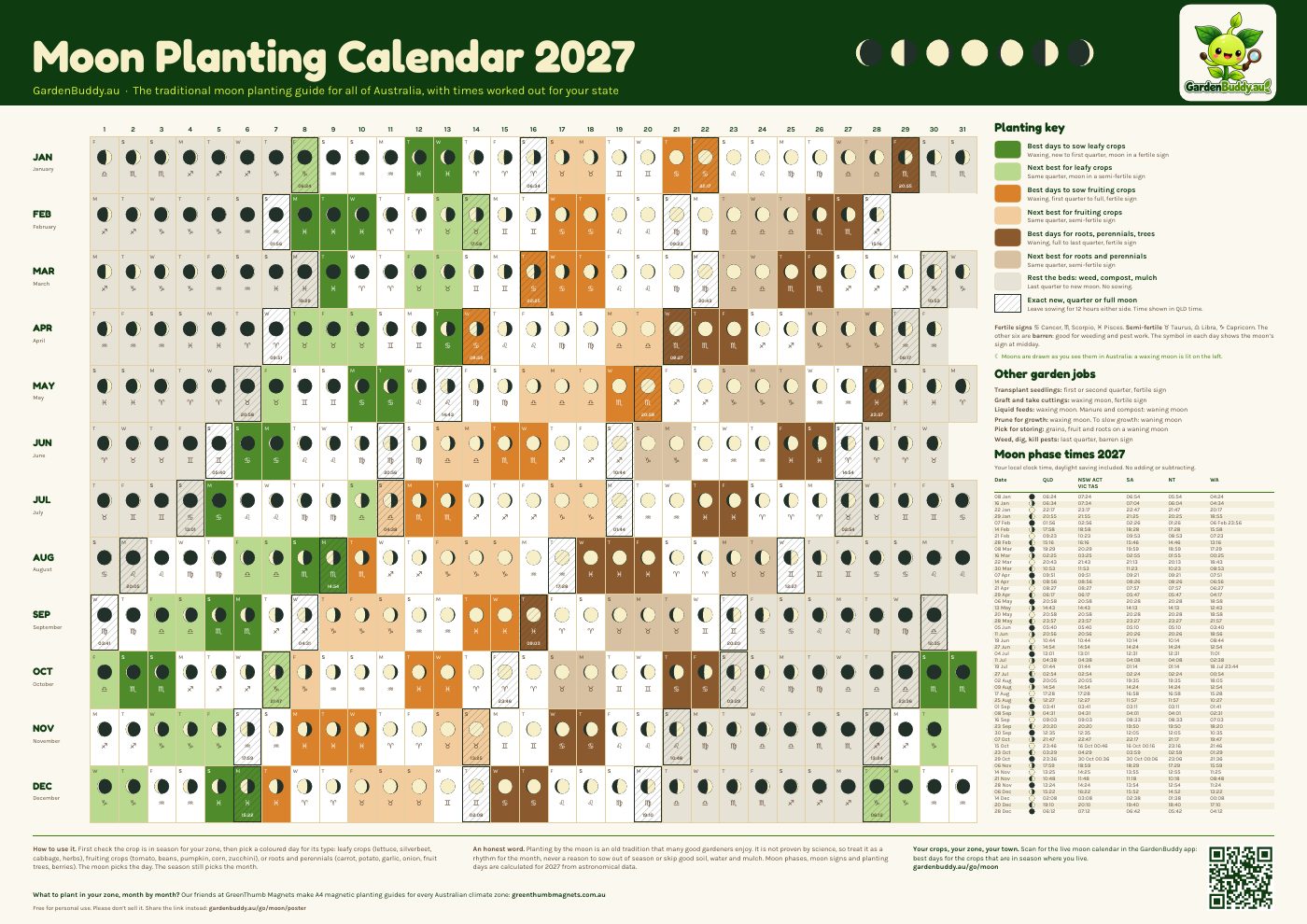
One A2 landscape sheet, January to December. Every day has a little moon, and we drew each one as it looks from Australia, so the waxing moon is lit on the left, not the right like in the northern hemisphere books. Behind each moon is a colour, and the colour is the whole point.
- Dark green, best for leafy crops. Waxing, from new moon to first quarter, with the moon in a fertile sign. Lettuce, silverbeet, spinach, cabbage, herbs. Light green is the next best, same quarter in a semi fertile sign.
- Dark orange, best for fruiting crops. Waxing, first quarter to full. Tomatoes, beans, pumpkin, cucumber, capsicum. Light orange is next best.
- Dark brown, best for roots, perennials and trees. Waning, full moon to last quarter. Carrots, beetroot, potatoes, onions, fruit trees, asparagus. Light brown is next best.
- Pale grey, rest the beds. Last quarter to new moon. No sowing. Weed, compost, mulch, fix the fence.
We boxed the days with an exact new, quarter or full moon. Leave sowing for about 12 hours either side of that moment. The times on the calendar grid are Queensland time.
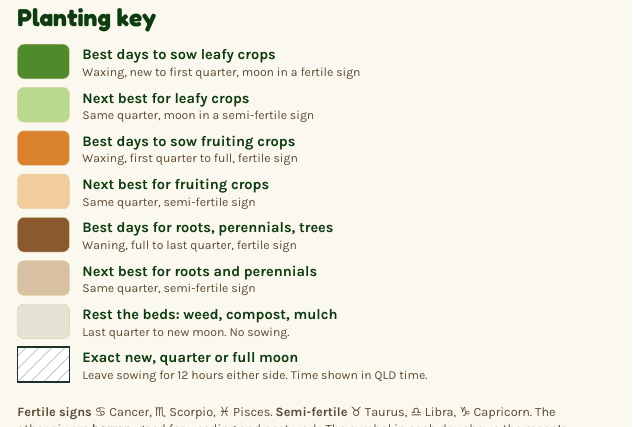
The fertile signs are Cancer, Scorpio and Pisces. Taurus, Libra and Capricorn are semi fertile. The other six are barren, which is not as bad as it sounds: barren days are good days for weeding and going after pests. The little symbol on each day shows which sign the moon is in at midday.
Down the right hand side we put a list of other garden jobs and when the moon suits them, transplanting, grafting and taking cuttings, liquid feeds and manure, pruning, picking for storage, and the weed, dig and pest work. Under that we added a moon phase table in local clock time, daylight saving included, for Queensland, NSW and the ACT, Victoria, Tasmania, South Australia, the Northern Territory and WA. So if you garden in Hobart you read your own column, not ours.
How to use it
Two steps, in this order. First, check the crop is in season for your zone. Our growing guides and your My Garden dashboard do that part. Then, inside that window, pick a coloured day that matches the crop type. The moon picks the day. The season still picks the month. A dark green day in January is no use for lettuce in Dayboro, the heat will bolt it jsut the same.
Right now the poster covers 2027 only, so it is ready to go up in the shed over Christmas. For the rest of 2026, and for the day by day detail on your phone, the live moon calendar is still there. The QR code in the bottom corner of the poster opens it.
An honest word
Moon planting isn’t proven by science. We say that on our poster as well. Gardeners have planted this way for a very long time, and plenty of us find it a useful rhythm: it spaces the sowing out, it gives the rest days a reason, and it gets you into the garden on a schedule. Treat it as a rhythm, not as a law, and don’t hold back a crop that is ready to go in because the colour is wrong.
How to get it
The poster is free for every paying GardenBuddy.au member, on Starter, Pro and Plant Check. Log in, open the poster page in our shop and press Download your copy. You get a PDF of about 1.3 MB. Download it as often as you like.
On the Free plan you can still look at the poster page, it shows you which plans include it. Join a paid plan, come back to the same page, and the button is waiting.
Getting it printed at Officeworks
A2 is 594 mm by 420 mm, four times an A4 page. A home printer won’t do it. Officeworks will, and the file is already set up the way they want it: exact A2, no bleed or trim marks needed, because they trim to the full size of the document. Here are the steps.
- Download the PDF from the poster page and save it somewhere you can find it.
- Go to the Officeworks Colour Posters page.
- Choose size A2 and landscape.
- Pick a paper. The standard choices are 160gsm Coated Bond, 200gsm Gloss Photographic and 200gsm Satin Photographic. We like satin for a shed, it does not throw glare back at you from the window.
- Upload the PDF. They take PDF, JPG, PNG and TIFF files up to 250 MB, so ours goes up without any fuss.
- Check the preview. The whole poster should fill the sheet, with the GardenBuddy.au heading at the top and the QR code bottom right.
- Choose pickup or delivery and pay. The price shows on the order page before you pay. We are not quoting a figure here because it changes, and the cheaper paper is not the same price as the photo paper.
Check the pickup options at checkout, some stores offer same day Click and Collect. Order it on a Friday and it can be on the wall in the weekend.
For a damp or humid shed, look at the Officeworks Premium Posters instead. One of the options there is a polypropylene film that is water resistant, which is a better bet than paper next to the potting bench in a Queensland summer. It costs more than the standard posters. Officeworks also sells A2 poster frames if you would rather put it behind glass.
Sharing it
The poster is free for personal use. Please don’t sell it. If a friend or the garden club wants one, share the link that is printed on the poster, gardenbuddy.au/go/moon/poster, rather than the file. That way they get the current version, and if we ever find a mistake in it, they get the fixed one.
Put 2027 on the wall
Paying members download it free from the poster page. Not a member yet, the plans page shows what each one includes.
GardenBuddy.au, built for subtropical vegetable growing at Dayboro, QLD. More about the project.
Published October 2026.