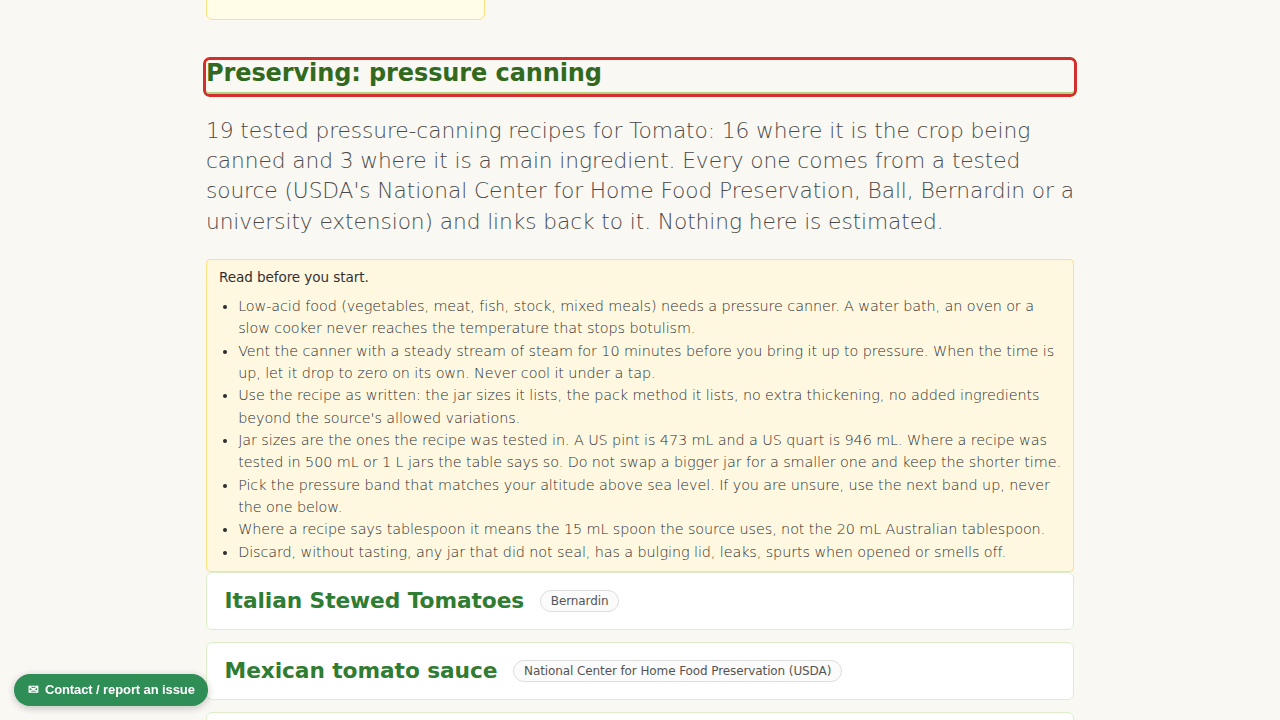
You grew it, you picked it, and now there is more of it than the fridge will take. Pressure canning is how a glut of tomatoes, beans, corn or pumpkin becomes a shelf of jars that keep for a year without a freezer. It is also the one preserving method where a guess can make you sick, because low acid vegetables need a tested time and pressure to be safe.
So we did not write our own recipes. We took lab tested ones and wrote every one of them up in Australian units: 250 mL, 500 mL and 1 L jars, kilograms and grams, millimetres of headspace, degrees Celsius, and the pressure in kPa. There are 121 of them, covering 35 of the crops in our guides.
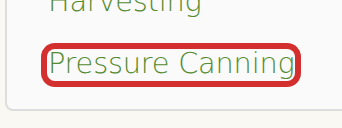
Where to find it. Open any veggie guide, say Tomato, and look at the contents strip under the title. The new entry is called Pressure Canning. We have outlined it in red below. Press it and the page jumps to the new section, which sits after Harvesting on every veggie guide that has a tested recipe.
Here is a short clip that walks through it: the top of the Tomato guide, the contents entry, the new section with its safety notes, and the first recipe folded open with its pressure table.
Each recipe folds open and gives you:
- The pack method, jar size, headspace and processing time.
- The pressure for a weighted gauge and for a dial gauge, listed by altitude band, in kPa with psi beside it, because most canner gauges sold here are still marked in psi.
- Ingredients in metric, the preparation steps in short, the expected yield, how to store the jars and how long they keep.
- The safety notes, the substitutions the recipe says you must not make, and the variations it does allow.

A few recipes give a time but no pressure figure. We show those with the time only and say so, rather than fill the gap ourselves.
Jar sizes are the nearest Australian jar to the one the recipe was tested in. One rule to keep: never use a bigger jar than the one listed, and never keep the shorter time for a bigger jar. A tablespoon in these recipes is 15 mL, not the 20 mL Australian tablespoon, so measure with a mL spoon.
The full recipe details are for members on a paid plan. If you are on the free plan you will still see which recipes exist for each crop, and a button to the plans page. Everything else on the veggie guides stays free.
One more thing you may notice. The veggie guide pages were missing their styling for a while, plain text with no cards or colour. That is fixed in the same release.