Got a plant that has gone the wrong colour, or a pest chewing through the leaves, and you are not sure what it is? GardenBuddy.au’s Free Plant Check answers that from a photo. Here is how to actually use it, step by step, on a real plant that is giving you trouble right now.
What it does and shows
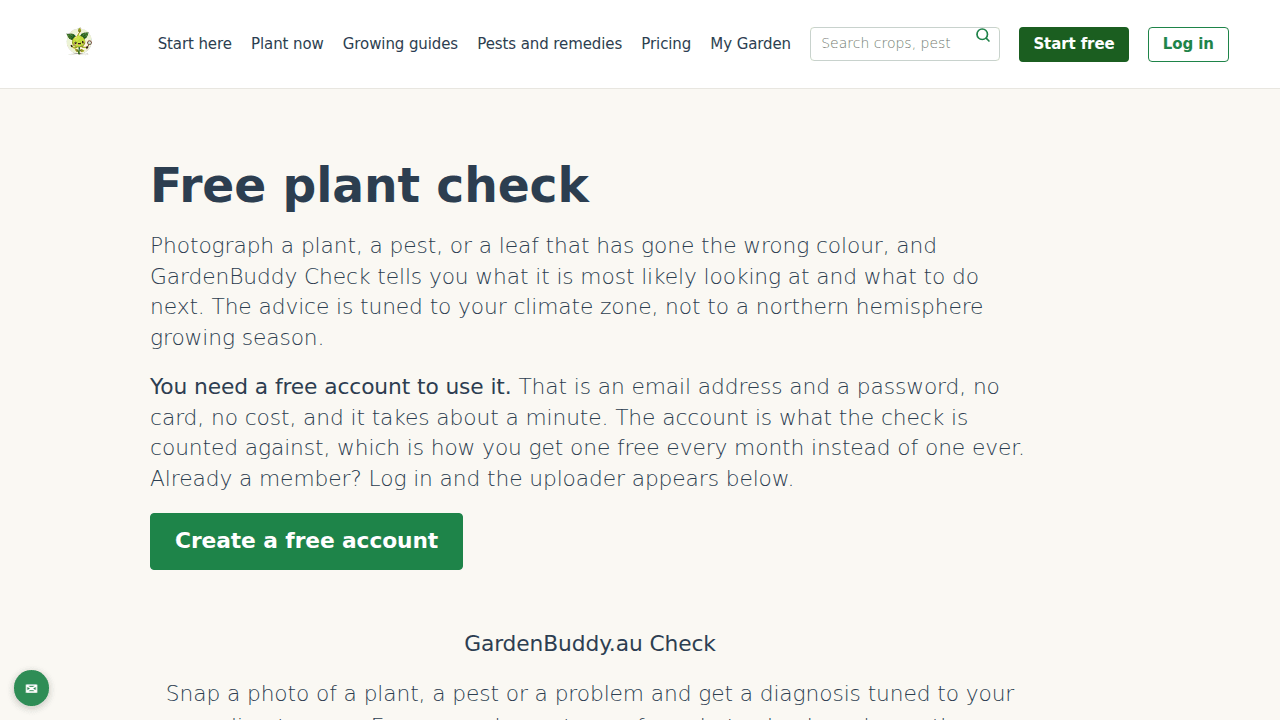
You photograph the plant, the pest, or the leaf that has gone wrong, upload it, and GardenBuddy.au Check tells you what it is most likely looking at and what to do next. The advice is tuned to your climate zone, not to a northern hemisphere growing season. If the plant is one of the roughly seventy vegetables and herbs the team has written guides for, the result comes back with a confidence percentage and a link straight through to the growing guide for your zone, so you get the diagnosis and the growing calendar in the one place.
Why it matters
Most home gardeners lose a plant to something that had an easy fix if it had been caught in time. Chewed leaves, curling tips, yellowing between the veins, a white powdery film, black spot, aphids, caterpillars, scale, fruit fly damage, the ordinary nutrient problems that show up as a pattern on the leaf. These are common, and they are usually treatable if you know what you are looking at. A photo check that answers in seconds, tuned to an Australian home garden rather than a generic overseas guide, is a genuinely useful shortcut when you are standing in the garden wondering what happened overnight.
How to use it, step by step
- Get a free account. Go to the Free Plant Check page. You need a free account to use it: an email address and a password, no card, no cost, about a minute to set up. That account is what the check is counted against, which is how you get one free check every month instead of one ever.
- Take the right photos. A whole plant shot so the pattern is visible, a close up of the actual damage, and the underside of a leaf if you suspect a disease. You can upload up to three photos. Only one is required, but more photos from different angles give the check more to work with.
- Log in and upload. Once you are logged in, the uploader appears on the page. Drop your photos into the slots and press “Run GardenBuddy.au Check”.
- Wait five to ten seconds. That is the typical turnaround for a diagnosis.
- Read the result and act on it. You get a likely identification with a confidence percentage. Where the plant is on the guide list, the result links straight to that growing guide. Where it is not, or the photo genuinely does not match anything on the list, it comes back as unknown rather than a confident wrong answer, because that is the safer failure mode.
Know the limits before you rely on it
Three hard limits, and they are deliberate. It does not identify mushrooms or other fungi. Getting a wild mushroom wrong can kill someone, so it refuses rather than guesses (a fungal disease on your plants, like powdery mildew, rust or botrytis, is a different thing and is still answerable). It does not look at people or animals, and will not comment on a rash, a bite or a sting. For anything you have eaten or touched, ring the Poisons Information Centre on 13 11 26. And it does not name chemical products or spray rates, because product registration in Australia is specific to the crop, the pest and the state, and it changes. The result tells you what the problem is and what your options are, then you check current registration on the APVMA register or ask at your local rural supply. It suggests an identification, it does not certify one. Check the answer against what you can actually see before you act on it.
FAQ
How many checks do I get for free?
One free photo check every calendar month, on any free account. It resets on the 1st.
Does it cost anything?
No. A free account costs nothing and needs no card. There is currently no paid one-off option available either, the team has that paused while it gets redesigned. If you check plants often, GardenBuddy.au’s paid plans include a larger monthly allowance.
What happens to my photo afterwards?
On a free account, your photo is analysed and then deleted. It is not kept in a history. Paying members get a saved history of their past checks.
What if it cannot work out what is wrong?
It answers “unknown” rather than guessing. The identification is restricted to a closed list of common Australian home garden vegetables and herbs, on purpose, so it does not confidently name something it has never actually been trained to recognise.
Related features
For the full detail on what the Free Plant Check does and where its limits are, see the GardenBuddy.au team’s Free Plant Check guide.