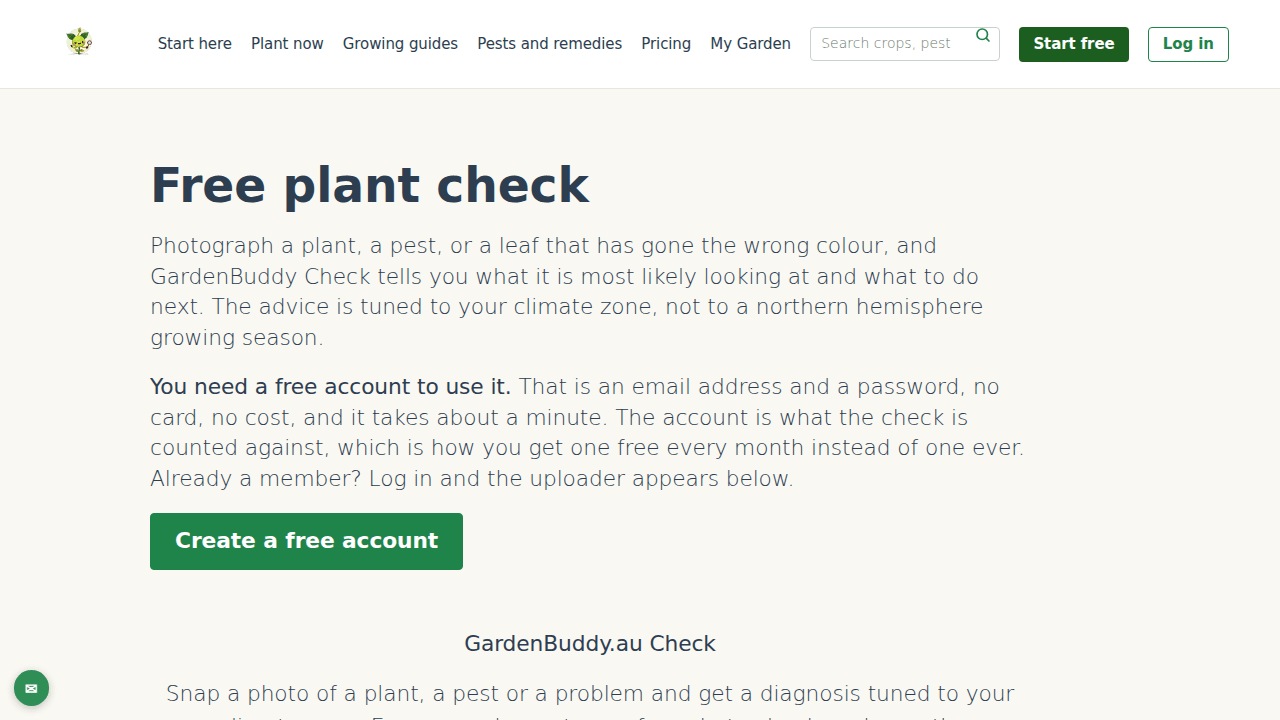
Photograph a plant, a pest, or a leaf that has gone the wrong colour, and the Free Plant Check tells you what it is most likely looking at and what to do next, tuned to your own climate zone rather than a northern hemisphere growing season. Here is what it actually does and how to use it.
A minute and a half on what the Free Plant Check does and where its limits are.
What it does
Upload one photo, or up to three if the problem is easier to see from more than one angle. A whole plant shot, a close up of the damage, and the underside of a leaf if you think it is a disease. An answer comes back in about five to ten seconds. Where the plant is one of the crops the GardenBuddy.au team writes guides for, the result links straight to the growing guide for your zone, so the treatment and the growing calendar come back together.
It is at its best on the seventy or so vegetables and herbs most commonly grown in Australian home gardens, which is the list it is allowed to name a plant from. Chewed leaves, curled tips, yellowing between the veins, powdery white film, black spot, aphids, caterpillars, scale, fruit fly damage, and the ordinary nutrient problems that show up as a pattern on the leaf are all in scope. Anything outside that list comes back as unknown rather than as a confident wrong answer.
Why it matters
Most home gardeners hit the same wall. Something has gone wrong with a plant, and the choices are ring around, post a photo in a Facebook group and wait, or guess and spray something that may not even be the right treatment. A free check that answers in seconds and is tuned to an Australian climate zone, not a generic overseas gardening site, closes that gap without a subscription or a card on file.
It also knows what it should not do, and says so plainly. It does not identify mushrooms or other fungi. Getting a wild mushroom wrong can kill someone, so it refuses rather than guesses, while a fungal disease on your plants such as powdery mildew, rust or botrytis is still answerable. It does not look at people or animals, and will not comment on a rash, a bite or a sting. For anything eaten or touched, ring the Poisons Information Centre on 13 11 26. It does not name chemical products or spray rates either, because product registration in Australia is specific to the crop, the pest and the state, and it changes. The result explains the problem and the options, then you check the current registration on the APVMA register or ask at your local rural supply. If it thinks it has found something that could be an exotic pest new to Australia, it stops and tells you to ring the Exotic Plant Pest Hotline on 1800 084 881, because that is a reportable matter and not something to diagnose from a photo.
One more thing worth saying plainly. It suggests an identification, it does not certify one. Check the answer against what you can actually see before you act on it.
How to use it
- Create a free account: an email address and a password, no card, no cost, about a minute to set up. The account is what the check counts against, which is how each member gets one free check every month instead of one ever.
- Log in and go back to the Free Plant Check page: the uploader appears once you are signed in.
- Upload one to three photos: a whole plant shot first, then a close up of the actual damage, then the underside of a leaf if disease is a possibility.
- Read the answer: it lands in five to ten seconds, with a link through to the matching growing guide when the crop is one of the ones tracked by name.
- Check it against what you can see: treat the answer as a strong suggestion, and follow the safety notes above for anything involving mushrooms, chemicals or an unusual pest.
Frequently asked questions
How many free checks do I get? One a month, and it resets on the first. That is a verified figure from the plugin code behind the feature, not a marketing round number.
What if I need another check before the month resets? A Pro membership includes twenty checks a month, along with the personalised digest and garden tracking. The pricing page lays out the full ladder. The site’s one-off, single-check paid pass is currently paused while the GardenBuddy.au team redesigns it, so it is not available to buy right now even though the older price is still visible in a couple of places on the site.
Does it work on any plant? No, and that is deliberate. It only names a plant from the roughly seventy vegetables and herbs most commonly grown in Australian home gardens. Outside that list it returns unknown rather than guessing.
Will it identify a mushroom growing in my lawn? No. Wild mushroom identification is refused outright, because a wrong answer there can be fatal. That refusal is a hard rule in the code, not a gap the team missed.
Related features
The Free Plant Check works best alongside a couple of the GardenBuddy.au team’s other guides.
- GardenBuddy.au Check now remembers every photo you send it: what changed when the check started keeping a history of past diagnoses.
- Plant Check: a five dollar answer for one problem plant: the story behind the one-off paid pass, currently paused while it is redesigned.
- Australian Grow Zone Map: find your climate zone so the advice that comes back with a diagnosis lines up with your own conditions.
- Veggie growing guides: the full library the Free Plant Check links out to when it recognises the crop.
Try it now
Head to the Free Plant Check page, create a free account if you do not already have one, and your first photo check is waiting. No card, no cost, and it resets every month.