

User guide · running your garden · 7 min read
Stop guessing, start planting in season.
Random planting is the biggest reason home gardens fail. Lettuce in a Brisbane November bolts within weeks; broccoli in a Melbourne February doesn’t head up. GardenBuddy.au gives you two free tools to figure out what’s actually sensible to put in the ground this month.
 Both planning tools are free and need no account. Try them before you sign up.
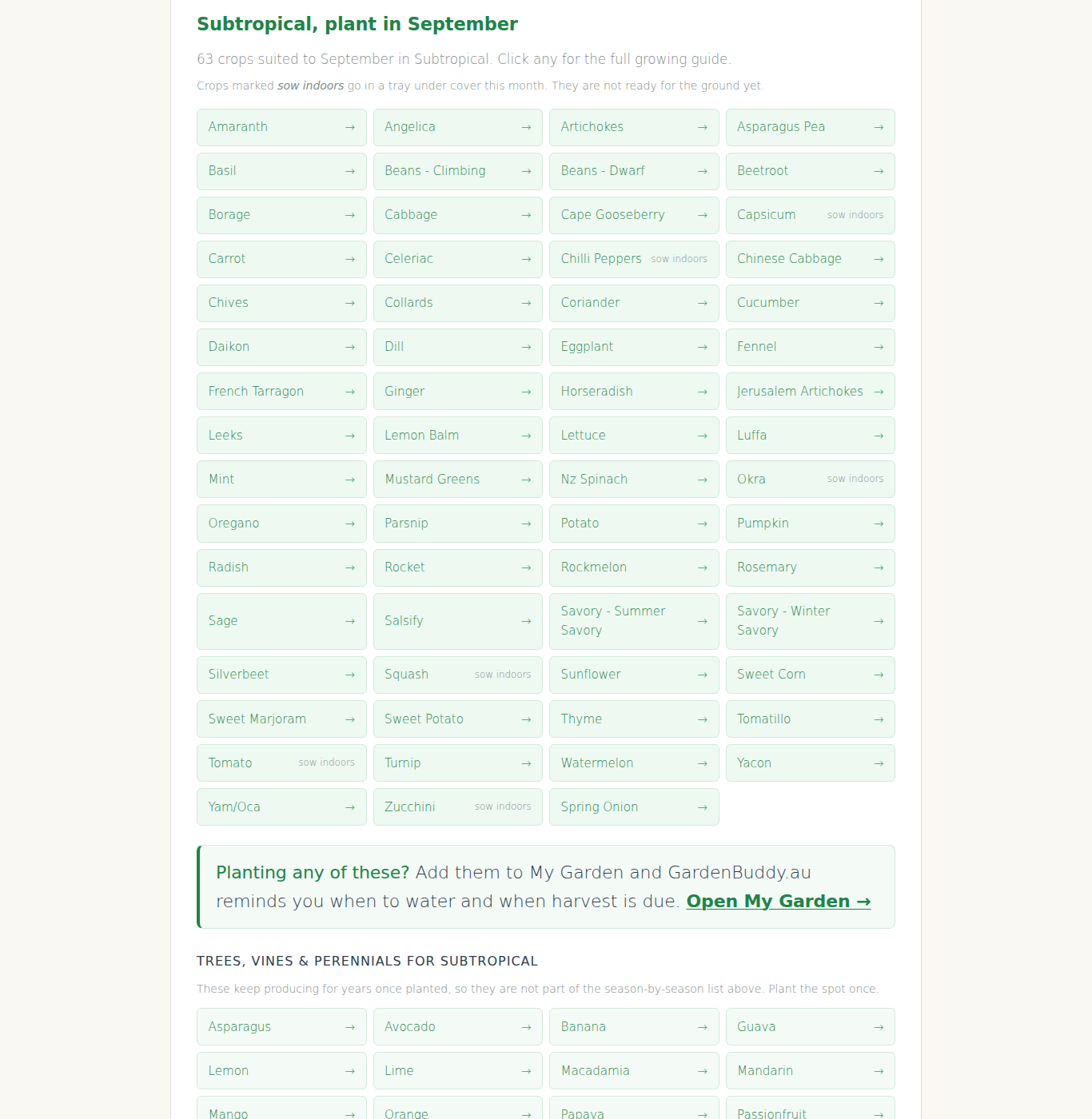
Use the Plant Now tool
Open /plant-now/. The page loads with today’s month and a zone picker. Click your zone, a list appears showing every crop in its optimal planting window for that zone right now.
April subtropical (Brisbane, Gold Coast, Sunshine Coast) returns 37 crops: broccoli, kale, silverbeet, snow peas, broad beans, bok choy, coriander, carrot, beetroot, peas, spinach, garlic, onion, leeks, lettuce, parsley, rocket, and more.
Different zone, same month, very different list
- April cool-temperate (Melbourne, Hobart): the cold-hardy subset, broad beans, garlic, broccoli, kale and the other brassicas.
- April tropical (Darwin, Cairns): the heat-tolerant build-up to dry season, sweet potato, amaranth, capsicum, climbing beans.
- April warm-temperate (Sydney): overlap with subtropical but with tighter windows for some crops.
- April Mediterranean (Perth, Adelaide): a similar cool-season list, broad beans, garlic, peas, spinach, silverbeet.
Pick 3–5 crops, not 15
First-time gardeners try to grow everything at once. Half the bed fails because each crop has different water, sun, and space needs, trying to meet all of them at once produces mediocre results across the board.
Pick 3–5 crops with a mix of harvest timing:
| Speed | Crops (subtropical autumn) | Days to harvest |
|---|---|---|
| Quick | Bok choy, radish, lettuce, rocket, mizuna | 30–50 |
| Medium | Silverbeet, spring onions, kale, beetroot, coriander | 50–90 |
| Slow | Broccoli, broad beans, garlic, onions, leeks | 90–210 |
| Herbs (perennial) | Parsley, thyme, oregano, chives | continuous |
That mix gives staggered harvest times instead of everything ripening at once. Bok choy ready week 6 while broccoli still heading; broad beans coming on as silverbeet slows; garlic in the ground for the long winter.
Worked example: 2 sqm raised bed, subtropical April, first-time grower
Good picks:
- 6× broccoli (Calabrese), 45 cm spacing, the centrepiece
- 6× silverbeet (Fordhook), 25 cm spacing along the front edge
- 2 rows bok choy (Shanghai), fast filler, re-sow every 2 weeks
- 1 pot of coriander (Slow Bolt), separate pot in partial shade
Result: first pick at week 6 (bok choy), continuous harvest from week 8 (silverbeet), main broccoli week 12, bok choy and coriander all through the winter.
Use the climate-zone guides
/veggie-guide/ has a landing page per zone. Click your zone, Brisbane → Subtropical, and you see a month-by-month planting chart for every crop, more than a hundred in total.
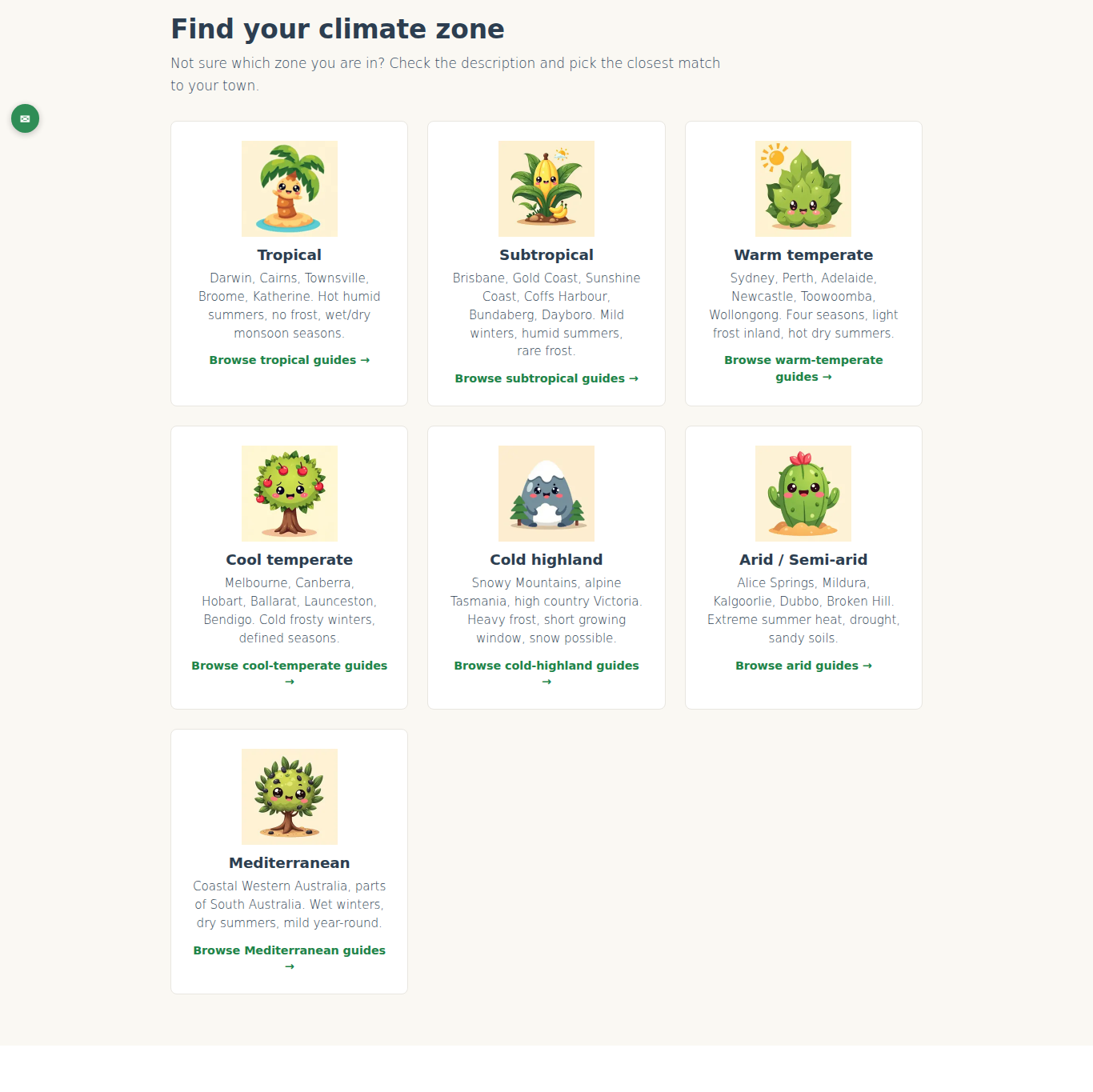
For any specific crop, the URL pattern /veggie-guide/{zone}/{crop}/ takes you straight to the planting window for that crop in your zone. Bookmark it for crops you grow regularly.
What the zone guide shows per crop
- 12-month planting calendar with optimal and marginal months marked
- Current month highlighted
- Soil temperature range for germination
- Typical days to harvest in your zone
- Companion plants and incompatibilities
- Pest warnings specific to your zone
- Variety recommendations that perform locally
Can I plant outside the recommended window?
Yes, but expect compromises:
- Slower growth, soil temperatures outside optimal slow germination and early development.
- More pest pressure, stressed plants attract pests that healthy ones shrug off.
- Possibly a failed crop, extreme out-of-window (broccoli in subtropical December, tomatoes in cool-temperate June) usually produces nothing usable.
The guide is based on 20+ years of Australian climate data. Outside its recommendations, you’re on your own.
A simple polytunnel or cloche extends your effective season by 4–6 weeks at each end. If you really want tomatoes in subtropical winter, a cloche over a north-facing bed gives you the temperature swing tomatoes need to fruit. Cost: about $30 of poly pipe + builder’s plastic.
Your microclimate may shift your effective zone
Within any backyard, three microclimate variables shift what grows:
- Aspect, north-facing beds (in the southern hemisphere) get more sun and run warmer. South-facing beds stay cooler and shadier.
- Wind shelter, a bed behind a fence or hedge is 2–3 °C warmer in winter than an exposed one.
- Frost pockets, low-lying corners of a block collect cold air and frost 5–7 days earlier than the rest of the garden.
After 2–3 seasons you learn your microclimates. Until then, plant to the zone average.
What’s next
Picked 3–5 crops. Next: add them to your bed in My Garden so the system can track them and calculate ROI later.